.jpg&w=1080&q=75)

A2A vs MCP: The Protocol War That Will Define How AI Agents Communicate

Theres a quiet infrastructure war happening in AI right now. Not about models. Not about chips. About protocols—the invisible plumbing that determines how AI agents access tools, share data, and coordinate with each other.
On one side: MCP (Model Context Protocol), backed by Anthropic, now pulling 97 million monthly SDK downloads and governed by the Linux Foundation. On the other: A2A (Agent-to-Agent Protocol), launched by Google, enabling agents to discover, communicate, and delegate tasks to one another across completely different platforms.
If youre building anything with AI agents in 2026, you need to understand both. Not because theyre competitors—but because they solve fundamentally different problems, and the real power comes from using them together.
The USB-C Port vs. The Common Language
MCP is the USB-C port. It standardizes how a single AI agent plugs into external tools, databases, and data sources. Before MCP, connecting an agent to your CRM, your GitHub repo, and your Slack workspace required building three separate custom integrations. MCP gives you one universal connector.
A2A is the common language. It standardizes how multiple AI agents talk to each other, share context, and coordinate tasks—even if they were built with different frameworks on different platforms.
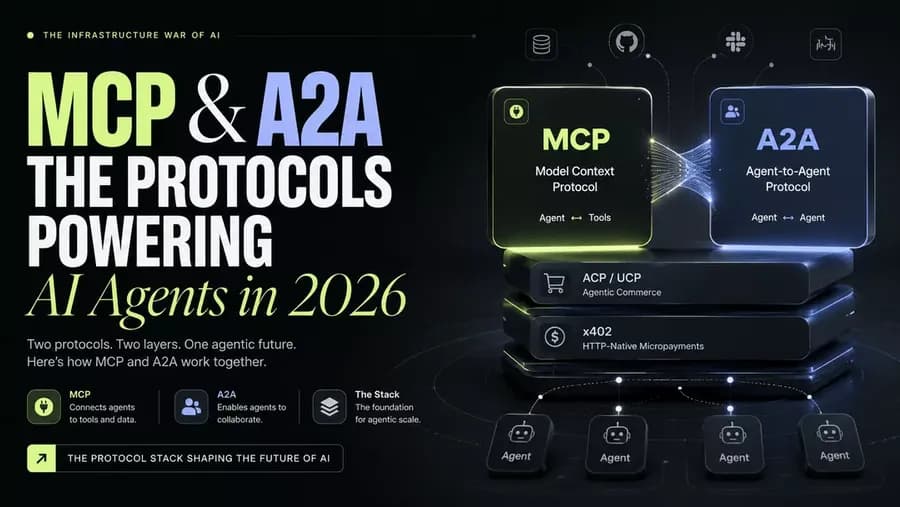
MCP handles the vertical: agent-to-tool connections. A2A handles the horizontal: agent-to-agent collaboration.
How Model Context Protocol (MCP) Works
MCP uses a clean client-server architecture with three core components: The MCP Host (the AI application), the MCP Client (the connector inside the host), and the MCP Server (the external service that exposes tools, resources, and prompts).
The protocol solved the N×M integration problem'—instead of building N custom connectors for M tools, you build one MCP server per tool, and every MCP-compatible agent can use it.
OpenAI deprecated its proprietary Assistants API in favor of MCP. When the two largest AI companies agree on a standard, adoption follows fast.
How Agent-to-Agent (A2A) Protocol Works
A2A addresses a completely different challenge: What happens when Agent A needs help from Agent B? It uses Agent Cards (JSON metadata describing an agents capabilities), Client Agents (the orchestrator), and Remote Agents (the executor).
The key insight: A2A doesnt care what framework the Remote Agent was built with. As long as it publishes an Agent Card and speaks the A2A protocol, any other agent can discover and interact with it.
Why Theyre Complementary, Not Competing
In modern agentic architecture, MCP and A2A operate at different layers. Layer 1 (Tool Access via MCP): Each individual agent uses MCP to connect to its own tools. Layer 2 (Agent Coordination via A2A): When agents need to collaborate, they use A2A.
Each agent is independently powerful (via MCP) and collaboratively intelligent (via A2A).
The Emerging Protocol Stack for 2026
MCP for tool and data access, A2A for agent coordination, ACP/UCP for agentic commerce, and x402 for HTTP-native micropayments. Together, these protocols are building the TCP/IP of AI.
What This Means for Builders
Use MCP for tool integration. Use A2A when you need multi-agent collaboration. Publish Agent Cards. Watch the commerce protocols. The companies that build on solid protocol foundations in 2026 will be the ones running reliable, scalable agent ecosystems in 2027.
Learn to build AI workflows that handle your busywork — live sessions, real projects, zero code.
See the courseBeginner-friendly