.jpg&w=1080&q=75)

Agent Sprawl: Why Your Company Has 47 AI Agents and Zero Governance

What Exactly Is Agent Sprawl?
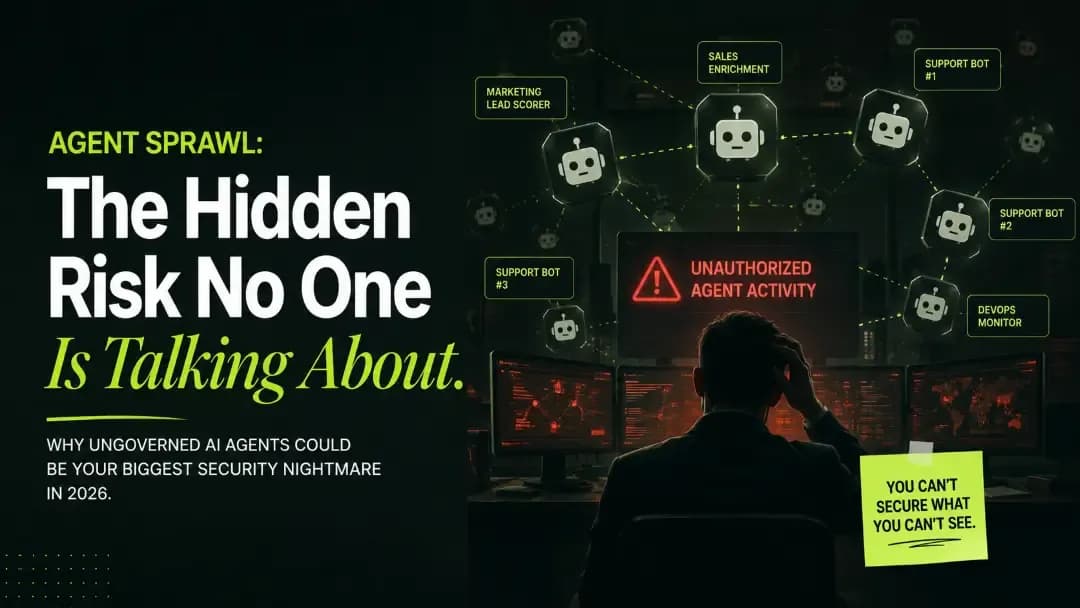
Your marketing team deployed a lead-scoring agent in January. Sales built a CRM enrichment agent in February. Customer support launched three chatbot agents in March. DevOps has two monitoring agents nobody remembers creating.
Nobody told the CISO.
Welcome toagent sprawl—the 2026 version of shadow IT, except this time the ungoverned software can think, act, and access your most sensitive systems autonomously.
According to recent industry data, 20% of organizations have already suffered security incidents linked to unauthorized AI agent use. And Gartners latest AI TRiSM (Trust, Risk, and Security Management) framework calls agent governance the single most underprepared area in enterprise AI strategy.
Agent sprawl occurs when departments independently deploy autonomous AI agents without centralized visibility, ownership, or security oversight. Unlike traditional shadow IT, these arent static tools. AI agents areautonomous, identity-bearing entitiesthat:
- Proactively execute multi-step workflows
- Access sensitive databases, CRMs, and APIs
- Interface with multiple external systems
- Make decisions without human oversight
- Run 24/7 with persistent memory
The 5 Hidden Risks of Uncontrolled Agent Deployment
1. The Expanded Attack Surface
Every unmonitored agent introduces new connections to SaaS applications, APIs, and data stores. Each connection is a potential entry point for attackers. If your marketing agent has read access to your CRM and your customer database, a single prompt injection attack could expose thousands of customer records.
2. Non-Human Identity (NHI) Crisis
Most enterprises have robust frameworks for managing human identities—SSO, MFA, role-based access. But AI agents? They often operate with:
- Excessive permissions (just give it admin access, its easier)
- Shared credentials across multiple agents
- Hardcoded API keys that never rotate
- No audit trail for actions taken
3. The Confused Deputy Problem
A trusted agent can be tricked into abusing its own privileges. An attacker doesnt need to compromise your system directly—they just need to craft a prompt that convinces your agent to access restricted data on their behalf. This isnt theoretical. Its happening in production environments today.
4. Cascading Multi-Agent Failures
In interconnected multi-agent systems, compromising one agent can grant access to every downstream agent in the chain. Agent A hands data to Agent B, which triggers Agent C. If Agent A is compromised, the entire pipeline is compromised.
5. Compliance and Regulatory Liability
Without centralized logging, you cant prove compliance. GDPR, SOC 2, HIPAA—every major framework requires audit trails. If your agents are making autonomous decisions about customer data, you need to prove exactly what decisions were made and why.
The Executive Confidence Gap
Recent surveys reveal a significant executive confidence gap'—a majority of leaders believe their existing AI policies are sufficient, while operational data tells a very different story. Fewer than half of enterprise agents are actively monitored.
The 5-Step Agent Governance Framework
Step 1: Build a Centralized Agent Inventory
You cant govern what you cant see. Start by discovering and cataloging every AI agent in your organization:
- What does it do? (Purpose and scope)
- Who deployed it? (Owner and department)
- What can it access? (Permissions and data sources)
- When was it last reviewed? (Lifecycle status)
Step 2: Treat Agents as First-Class Identities
Stop managing agents as simple applications. They need the same identity governance as human users:
- Scoped, least-privilege access
- Verifiable credentials that rotate automatically
- Individual audit trails per agent
- Formal onboarding and offboarding processes
Step 3: Standardize the Agent Lifecycle
Create a formal approval workflow for agent deployment:
- Proposal: What problem does this agent solve?
- Risk Assessment: What data will it access? What could go wrong?
- Approval: Security and compliance sign-off
- Deployment: Using approved frameworks and security standards
- Monitoring: Continuous behavior tracking
- Retirement: Automated decommissioning of orphaned agents
Step 4: Implement Continuous Monitoring
Deploy AI TRiSM tools to:
- Monitor agent behavior in real-time
- Detect anomalous actions (unexpected API calls, data access patterns)
- Ensure compliance with security policies
- Alert on potential prompt injection attempts
Step 5: Design Risk-Based Human Oversight
Not every agent action needs human approval. Design oversight mechanisms based on the agents risk level:
- Low risk(scheduling, summarization): Full autonomy
- Medium risk(data analysis, content generation): Periodic review
- High risk(financial transactions, customer data): Human-in-the-loop required
What Happens If You Dont Act
The companies that build agent governance frameworks in 2026 will be the ones that scale AI confidently in 2027. The companies that dont will be the ones explaining to regulators why an unsupervised AI agent leaked customer data, made unauthorized financial decisions, or hallucinated its way through a compliance audit.
Agent sprawl isnt a future problem. Its happening right now, in your organization, today. The question isnt whether you have ungoverned agents. The question is how many—and what theyre doing while nobodys watching.
Learn to build AI workflows that handle your busywork — live sessions, real projects, zero code.
See the courseBeginner-friendly