.jpg&w=1080&q=75)

The Complete AI Agent Tech Stack in 2026: From Models to Memory

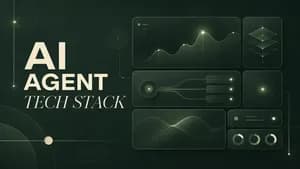
Building an AI agent in 2026 is no longer about picking a model and writing a prompt. Its about assembling a multi-layer architecture where each component serves a distinct purpose—reasoning, orchestration, memory, and tool integration.
The 4-Layer Architecture
Layer 1: The Reasoning Layer (The Brain). The cognitive core—the LLM or multimodal model that interprets inputs, decomposes goals into steps, and decides what to do next. Leading options include Claude Opus 4 (best instruction following), GPT-5 (broad capability), Gemini 2.5 Pro (native multimodality), Llama 4 (open-source, self-hosted), and Qwen 3 (strong reasoning, efficient).
Layer 2: The Orchestration Layer (The Manager). The execution logic that turns reasoning into actions. Handles the Plan, Act, Observe, Adapt loop. Leading frameworks: LangGraph (industry standard for complex, stateful workflows), CrewAI (role-based multi-agent systems), AutoGen/AG2 (multi-agent conversations), PydanticAI (type-safe structured outputs), and model-specific SDKs for rapid prototyping.
Layer 3: Memory and Data (The Knowledge). Operational Memory (short-term) includes buffer memory, sliding window, and summary memory. Learned Memory (long-term) uses vector databases (Pinecone, Weaviate, Qdrant) for RAG, knowledge graphs for structured relationships, and durable state for checkpointing.
Layer 4: Tool Integration (The Hands). MCP (Model Context Protocol) is the standard for 2026 with 97M+ monthly SDK downloads. Common tool categories: data access, communication, code execution, web browsing, and specialized tools.
The Observability Layer (Bonus)
Essential for production: LangSmith for tracing agent reasoning loops, custom tracing for logging every decision point, and human-in-the-loop dashboards. Without observability, a production agent is a black box.
Reference Architecture
For a multi-agent content creation system: Claude Opus 4 for reasoning, CrewAI for orchestration, Qdrant plus Buffer Memory for data, MCP servers for tools, LangSmith for observability, and MCP plus A2A for protocols.
Selection Strategy: Complex stateful workflows need LangGraph, role-based collaboration needs CrewAI, type-safe Python development needs PydanticAI, and quick prototypes use model SDKs. The key insight: you dont need a frontier model for every task. Use the cheapest model that produces acceptable output for each step.
Learn to build AI workflows that handle your busywork — live sessions, real projects, zero code.
See the courseBeginner-friendly