.jpg&w=1080&q=75)

AI Cost Optimization: How to Slash Your API Bills with FinOps for AI

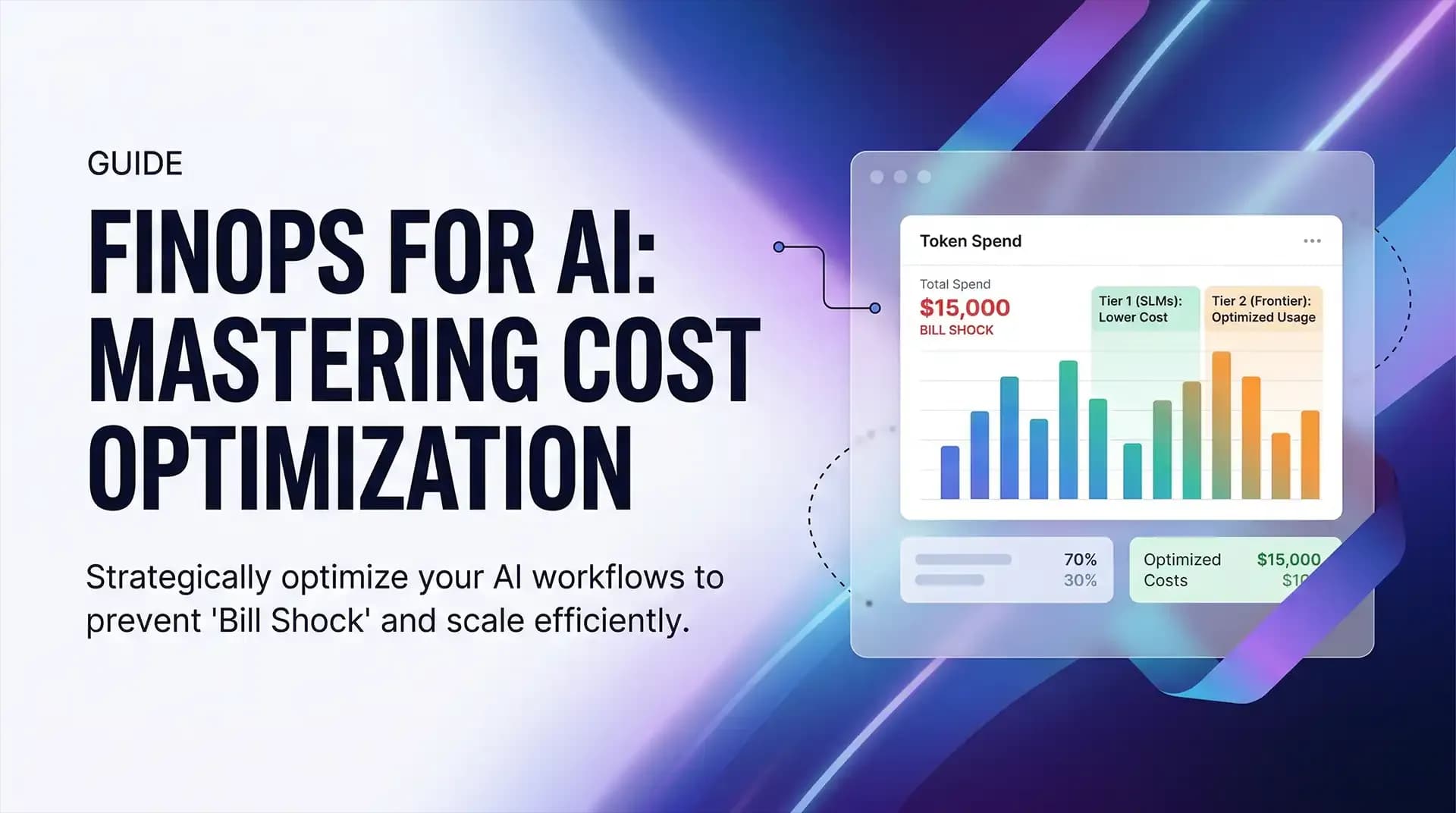
It starts with a $100 pilot project. You build a sleek prototype, the team loves it, and you move to production. Three months later, your CFO is knocking on your door with a $15,000 monthly API bill they didnt authorize. Welcome to the \'AI Bill Shock\''—the single biggest killer of AI startups in 2026.
If you want to scale your AI workflows without going bankrupt, you need to masterAI cost optimizationthrough a new discipline:FinOps for AI.
The AI Bill Shock: Why Your Infrastructure Costs are Spiraling
The era of cheap, experimental AI is over. As businesses move from simple chatbots to complexAgentic Loops, the math changes. An autonomous agent tasked with \'researching a competitor\ might make 50-100 API calls in a single session. If those calls are hitting a frontier model with a massive context window, a single user session could cost dollars, not cents.
Without proper guards, agents can enter \'hallucination loops\ or recursive reasoning cycles that burn through your credits while you sleep.Reducing AI infrastructure costsis no longer optional; it is the foundation of a viable business model.
Understanding the \'Cognitive Effort Paradox\
The most common mistake in AI development is the \'over-spec\ error. Many developers use GPT-4o or Claude Opus forever'ypart of their pipeline. This is the \'Cognitive Effort Paradox\: over-paying for intelligence you dont need.
Think of it like this: You wouldnt hire a PhD in Mathematics to solve basic addition. Similarly, you shouldnt use a trillion-parameter model to summarize a 200-word email or extract a JSON object from a predictable text block.
The Tiered Intelligence Strategy:
- Tier 1 (SLMs):Use models like Llama 3-8B or Gemini Flash for data extraction, formatting, and PII scrubbing. This is the most efficient choice for high-volume, low-logic tasks.
- Tier 2 (Frontier Models):Reserve the major engines for multi-step reasoning, creative synthesis, and high-stakes planning.
By applying this tiered approach, you can cut your API spend by up to 60% without losing performance.
5 Tactical Token-Saving Strategies for 2026
If you want to optimize your spend immediately, focus on these fivetoken optimization strategies:
- Prompt Caching:Leverage native caching features (like DeepSpeed or Anthropic’s prompt caching) to store static system instructions so you arent billed for them on every turn.
- System Prompt Compression:Every word in your system prompt is a recurring cost. Audit your prompts and remove \'fluff.'\ Use concise, descriptive instructions.
- Few-Shot Pruning:Dont provide 10 examples when 2 will do. Monitor your accuracy and trim examples to the bare minimum.
- Schema Enforcement:Using \'Structured Output\ (JSON mode) prevents LLMs from writing verbose \'yappiness\ before giving the answer, saving thousands of tokens per hour.
- Output Token Limiting:Hard-cap your completions. If you only need a 1-word answer, set
max_tokens: 1.
Hybrid Architecture: When to Use the Cloud vs. Local Models
In 2026, the most successful companies are using hybrid models. This involvesmodel offloading—running internal, non-critical tasks on local servers.
By hosting a local instance of Llama 3 or Mistral on your own hardware, you eliminate the per-token cost entirely for tasks like internal document indexing, PII scrubbing, and basic classification. You save the \'Cloud Credits\ for the high-reasoning tasks that require frontier-level intelligence. When comparingLLM API pricing, remember that the cheapest API is the one you dont have to call.
Caching & Persistence: Never Pay for the Same Prompt Twice
The ultimate \'hack\ for AI efficiency is a semantic cache. Most AI applications receive similar queries repeatedly. By implementing a storage layer (like Redis or PostgreSQL with Vector search), you can check if a similar question has been answered before. If it has, you serve the cached response for $0 in API costs. This technique alone can show a 40% reduction in API spend for high-volume support bots.
Conclusion / CTA
AI profitability isnt just about revenue—its about margin. As the market matures, the winners will be determined not just by who has the smartest models, but by who can run those models most efficiently.
Ready to stop the bleeding?Download our\'AI Budget Calculator\at Zero To AI to project your 2026 infrastructure spend and find the hidden leaks in your pipeline.
FAQ (People Also Ask)
- What is FinOps for AI?It is the practice of combining financial management with AI engineering to optimize the cost, performance, and efficiency of AI workloads.
- How do I calculate LLM costs?You must track Input Tokens (context), Output Tokens (completion), and any overhead from caching or tool-use calls.
- Is open-source AI always cheaper?Not always. You must factor in GPU hosting, maintenance, and engineering time. However, for high-volume tasks, it usually offers a better TCO.

Learn to build AI workflows that handle your busywork — live sessions, real projects, zero code.
See the courseBeginner-friendly