.jpg&w=1080&q=75)
AI Courses Are India's New Craze. Do They Get You Hired?

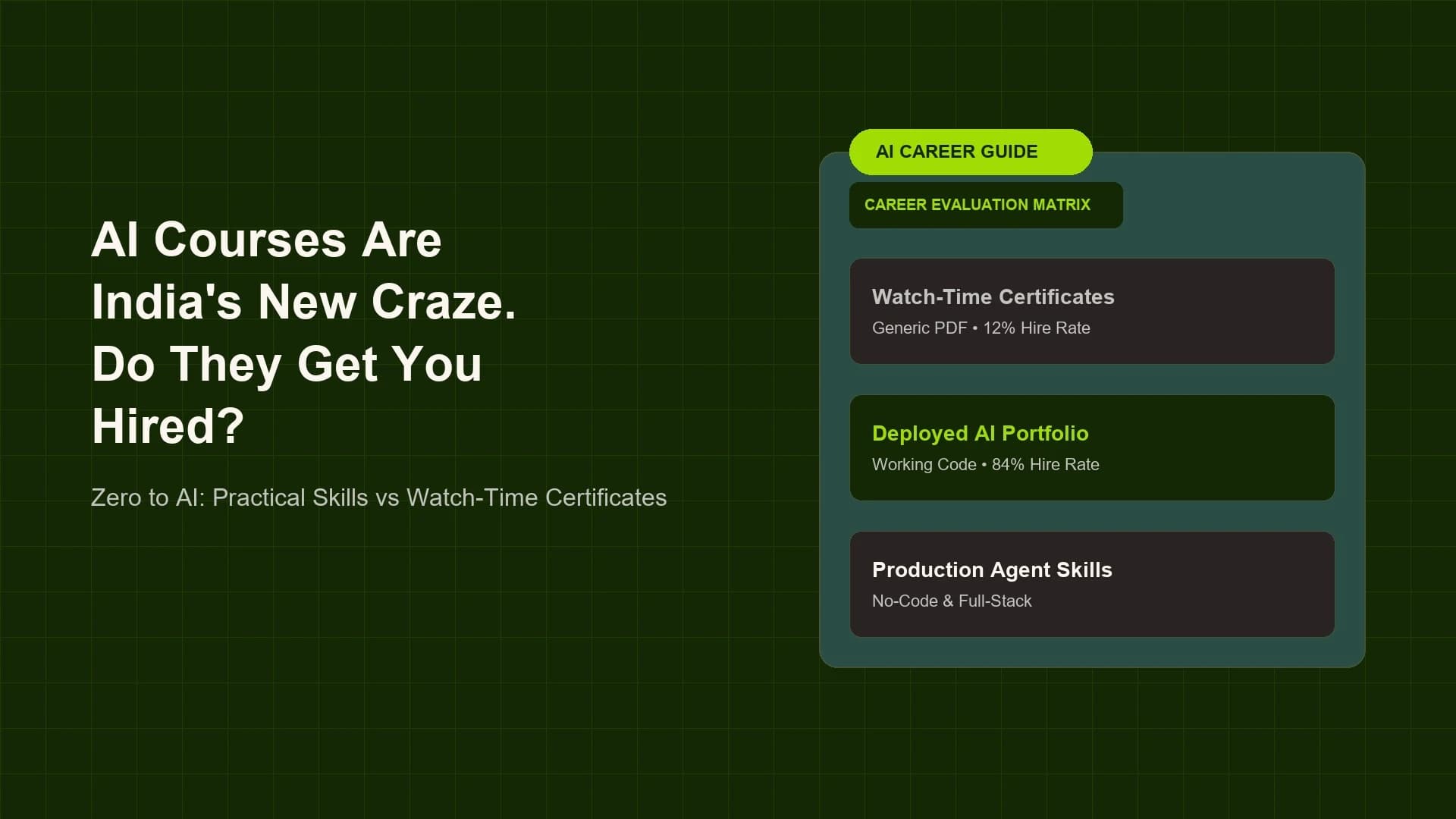
Not reliably, on their own. A CAG audit of India's PMKVY skilling programme, reported by Analytics India Magazine on 12 August 2026, found that only 41% of people trained under earlier phases secured placements. An AI certificate course helps your odds, but the certificate itself isn't what gets you hired — what you can demonstrably do with the skill is.
AI courses are everywhere right now, and most of them lead with the certificate as the selling point. That's backwards. The government's own skilling programme just got caught not tracking whether its "future-skills" training — including AI — actually leads to jobs. If the country's biggest training initiative can't prove its certificates work, it's worth asking the same question about the ₹1,499 or ₹1,50,000 course you're considering.
What the Audit Actually Found
India trained roughly 5.4 lakh candidates in future-skills programmes between FY2023-24 and June 2026, with 4.48 lakh of those in 2024-25 alone. But under the CAG's review of earlier PMKVY phases, only 41% of trained candidates — 23.18 lakh out of a much larger pool — secured actual placements. More pointedly, the Ministry of Skill Development confirmed it has stopped tracking placements under the current PMKVY 4.0 phase entirely, arguing the programme now supports "diverse career paths" rather than traditional employment.
Sumesh Nair of Board Infinity, quoted in the same report, made the sharper point: AI-skilling programmes should be measured with a verified employment scorecard — six-month and twelve-month employment outcomes — not course completion numbers. That's the standard every course, government or private, should be held to.
Why a Certificate Alone Rarely Moves the Needle
A certificate proves you finished something. It does not prove you can do something. An employer or client evaluating you for AI-related work is trying to answer one question: can this person actually build or operate an AI workflow? A certificate answers "did they show up." It doesn't answer the question that matters.
This is exactly the gap the CAG audit is describing at a national scale — lots of completions, unclear whether any of it translated into real capability someone would pay for.
What an AI Certificate Course Should Actually Include
- A shipped project, not just a completion badge. Something you built during the course that still works after it ends — an agent, an automation, a working demo.
- Specifics you can name in an interview. "I built a WhatsApp lead-qualification bot using n8n and Claude" beats "I completed an AI fundamentals certificate" every time.
- A portfolio, not just a PDF. A certificate lives in a folder. A portfolio project lives on a screen you can share in an interview or a client pitch.
Zero To AI's courses, for example, pair a completion certificate with a required portfolio project specifically because of this gap — the certificate alone was never going to be the thing that got anyone hired. You can see the full breakdown of what's included at each price point in our [Zero To AI course review](/blogs/zero-to-ai-course-review-2026).
What Employers Actually Say They Want
Sumesh Nair's framing in the CAG-audit coverage — a "verified employment-and-performance scorecard" over course-completion numbers — matches what shows up constantly in hiring conversations for AI-adjacent roles. Nobody is asking candidates to recite a syllabus. They're asking "show me something you built," and a certificate PDF is not an answer to that question.
This is also why course length is a weak signal on its own. A six-month programme that ends in an exam produces the same employability outcome as a two-week programme that ends in an exam: a piece of paper. The variable that actually matters is whether a real, demonstrable project sits at the end of either path.
Walkthrough: Turning a Certificate Into Something Employable
- Finish the course with a real, working output — not notes, an actual agent or automation that runs.
- Record a 60-second screen capture showing it working end to end. This becomes your proof, not the certificate PDF.
- Write two sentences describing what problem it solves and what tools you used — this is what goes in your resume or a client DM, not "AI certified."
- Show it, don't just claim it. In an interview or client conversation, share the recording or a live demo before you mention the certificate at all.
If you're starting from zero and want a course structured around this exact output, our [AI agent building course](/courses) is built so the project comes before the certificate, not after it.
Free vs Paid AI Certificate Courses
Type | Certificate Value | What Actually Helps You Get Hired |
|---|---|---|
Free government programmes (PMKVY-style) | Government-recognised, but per the CAG audit, placement outcomes are inconsistently tracked | Depends entirely on whether the specific course included a real project |
University-partnered programmes | Strong institutional name | Usually yes, if the programme includes a capstone project, not just exams |
Project-based paid courses (e.g. Zero To AI) | Platform-issued, not government-recognised | The shipped project is the actual asset, more than the certificate itself |
None of these categories is automatically better. The audit's lesson applies to all of them equally: check for a real project before you check the credibility of the certificate. If you're weighing the cost side of that decision too, our [honest breakdown of AI course fees in India](/blogs/ai-course-fees-india-2026-honest-breakdown) covers what each category actually costs once discounts and add-ons are accounted for, and our related piece on [what the best beginner AI course actually needs to teach](/blogs/only-20-percent-india-builds-with-ai-2026) goes deeper into the project-vs-theory question this same audit is really about.
The Uncomfortable Part of This Audit
The most striking detail in the CAG's findings isn't the 41% placement rate — outcomes below half are common across skilling programmes worldwide. It's that the government stopped measuring the number entirely once it got uncomfortable. That's a pattern worth recognising in any course you're evaluating, not just government ones: if a program is reluctant to publish or track its outcomes, that reluctance is itself information.
A course confident in its results will show you former students' actual projects, not just testimonials about how the course "changed their life." If a course can't point to specific, nameable things graduates built, treat that absence the same way the CAG treated PMKVY 4.0's missing placement data — as a gap worth asking about directly, before you pay.
The Bottom Line on Any AI Certificate Course
Choose based on what you'll build, not what you'll be handed at the end. A ₹0 government programme, a ₹1,50,000 university programme, and a ₹1,499 project-based course can all leave you exactly where you started if none of them force you to ship something real. The CAG audit is a national-scale version of a question every individual course-shopper should already be asking before enrolling: not "will I get a certificate," but "will I have something I can actually show for it."
Frequently Asked Questions
Does an AI certificate actually help you get a job?
It helps, but it rarely gets you hired on its own. A CAG audit found only 41% of candidates trained under earlier government skilling phases secured placements, and the current programme no longer even tracks that outcome. A shipped project you can demonstrate matters more than the certificate itself.
Are free government AI courses worth it if they don't track placements?
They can still be worth it for the skill itself, but go in knowing the government has stopped measuring whether its own AI-skilling programme leads to jobs. Treat the certificate as a starting point, and make sure you finish with something real you built, not just attendance.
Does Zero To AI give a certificate?
Yes — every Zero To AI course includes a shareable completion certificate, paired with a required portfolio project you build during the course itself. The portfolio project, not the certificate alone, is the part you'd actually show a client or employer when they ask what you can do, not just what you completed.
What should I look for instead of just a certificate?
Look for a course that ends with something you built and can demonstrate — a working agent, automation, or project — plus a specific, nameable skill you can describe in one sentence. That combination is what an employer or client is actually evaluating, not the certificate PDF itself.
Learn to build AI workflows that handle your busywork — live sessions, real projects, zero code.
See the courseBeginner-friendly