.jpg&w=1080&q=75)
AI Orchestrator Roadmap: Reskill from User to Conductor

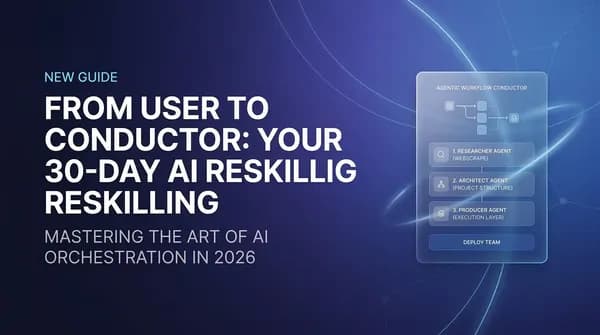
AI Orchestrator Roadmap: Reskill from User to Conductor
The announcement of GPT-5.4 in mid-2026 fundamentally changed the rules of work. For the last few years, the world was obsessed with prompt engineering—the art of talking to a machine. But as agents gained native computer-use capabilities, the skill of prompting became a commodity.
Today, the most valuable professionals arent the ones writing the best prompts; they are the ones designing the best systems. We call this the shift fromUser to Conductor.
In 2026,AI reskilling 2026isnt about learning a new tool; its about learning a new hierarchy where you are the strategist and the agents are your workforce. Here is your 30-day roadmap to making the jump.
The Automation Paradox: Why AI Users are Being Automated
It sounds like a contradiction: how can the very people using AI be the ones at risk of being replaced by it?
The answer lies in theAutomation Paradox. GPT-5.4 doesnt just need a prompt—it needs an objective. If your primary value is I know how to tell ChatGPT to write an email, you are still a worker in the Execution Layer. And in 2026, the execution layer is free.
To stay relevant, you must move up into theOrchestration Layer. An AI Orchestrator doesnt just use a tool; they build a team of autonomous agents—one for research, one for drafting, and one for quality assurance—and manage the output.
Week 1: Mapping the Execution Tax
Your first seven days are about auditing your routine to find what we call theExecution Tax. These are the hours you spend on doing rather than thinking.
- Step 1: List every task you performed this week.
- Step 2: Label them as Strategic (requires judgment) or Routine (follows a pattern).
- Step 3: Identify the routine tasks that can be handled by an autonomous worker.
By the end of Week 1, your goal is to have saved five hours of your week by offloading one routine process to a basic agentic workflow. This is whereAI literacybecomes real—not as a concept, but as a reclaimed resource.
Week 2-3: Defining Your Agentic Workforce
Now that you’ve found the time, you need to build your team. In the 2026 economy,autonomous agentsare specialized. You wouldnt hire a single person to be your CEO, Accountant, and Janitor; you shouldnt expect one AI model to do everything either.
During these two weeks, you should master the Agentic Node concept. Whether you usen8n, LangGraph, or specialized frameworks like CrewAI, you are learning to connect these nodes into a cohesive unit.
- The Researcher: Scrapes the web and filters data.
- The Architect: Structures the project or outline.
- The Producer: Executes the first draft or code.
- The Auditor: Checks against your specific brand voice.
You are no longer a writer or a coder. You are anArchitect of workflows.
The most successful professionals of 2026 are those who can imagine a process and then instruct an agentic squad to build it while they sleep. — Zero To AI Strategy Brief
Week 4: The Conductors Mindset (Governance & Taste)
The final week is about the Human Premium. Once your agents are running, you face a new problem:Agent Sprawl. If you have 50 agents running 50 tasks, you need a governance framework.
This is whereethical orchestrationcomes in. You are the moral and aesthetic compass for your digital workforce.
- Judgment: Deciding which AI-generated path is the right one for your brand.
- T'aste: Recognizing when an output is technically correct but spiritually flat.
- Ethics: Ensuring your agents arent hallucinating data or violating privacy.
You have now moved from being a Digital Worker to anAI Orchestrator. You dont play the violin; you ensure the entire orchestra is playing the same song, in the right key, for the right audience.
Conclusion: Stop Competing, Start Directing
The fear ofAI reskilling 2026only exists for those who refuse to step into the Conductors seat. GPT-5.4 is the greatest employee you’ve ever had, but it’s a terrible leader.
The market has never been more competitive for workers, but it has never been more rewarding for leaders. By following this 30-day roadmap, you stop fighting for a seat in the orchestra and start owning the stage.
Ready to take the Conductors seat?
[Join the Zero To AI Conductor Workshop] and build your first autonomous multi-agent team in just 48 hours.
FAQ (People Also Ask)
Q: Do I need to be a coder to be an Orchestrator?No. In 2026, the best orchestration tools are visual and no-code. You need to understandlogicandprocess, not syntax.
Q: How many agents should I start with?Start with a Team of Two. One Agent to execute a task and one Agent to audit it. This introduces you to the Multi-Agent feedback loop immediately.
Q: Is Prompt Engineering still useful?It’s a foundational skill, like typing. But Strategic Intent and System Design are the skills with the higher salary cap in 2026.
Learn to build AI workflows that handle your busywork — live sessions, real projects, zero code.
See the courseBeginner-friendly