.jpg&w=1080&q=75)

AI Laws Are Coming: What the 2026 Regulation Wave Means for Small Businesses

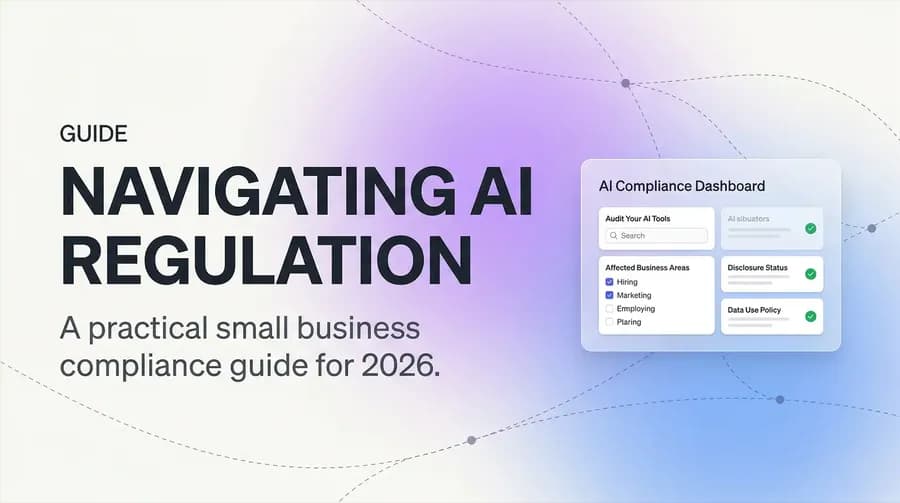
In March 2026, Washington state passed two significant AI bills — SB 5838 and HB 1951 — covering automated decision-making, AI disclosure requirements, and algorithmic accountability. As of this writing, more than 30 states have AI-related legislation either passed, pending, or in active committee. The EU AI Act began full enforcement in 2025.
If you run a small business and use AI tools — for customer service, marketing, hiring, or anything else — AI regulation and small business compliance in 2026 is no longer a future concern. It is a present-tense question.
What the New AI Laws Actually Say
Washington State SB 5838 targets consequential decisions — decisions that materially affect a persons access to employment, housing, credit, healthcare, education, or essential services. If your business uses an AI tool to screen job applicants or assess tenant applications, this law directly applies. It requires you to notify individuals when AI is used in such decisions and give them the right to request a human review.
Washington State HB 1951 focuses on AI-generated content disclosure. If your business uses AI to generate content — text, images, audio, or video — that could be mistaken for human-created content in a commercial context, you are required to disclose that AI was involved.
The EU AI Act, now in full enforcement, classifies AI systems by risk level. High-risk uses including biometric identification, employment screening, and credit scoring face strict requirements including human oversight, documentation, and registration.
The important takeaway: these laws are not primarily targeting AI developers. They are targeting AI users — the businesses that deploy AI tools to interact with customers or make decisions about them.
Which Types of Small Businesses Are Most Affected
High exposure: hiring and recruitment using AI to screen resumes or rank candidates, real estate and lending using AI for tenant or credit assessment, healthcare-adjacent services using AI recommendations, and e-commerce personalization setting prices dynamically.
Moderate exposure: AI chatbots for customer service (multiple state laws require disclosure), AI-generated marketing content in advertising contexts, and AI-assisted content creation in paid promotional contexts.
Lower exposure: freelancers using AI internally with no direct consumer-facing AI deployment.
What You Need to Do Right Now
First, audit your AI use. Write down every AI tool you use and categorize each one: internal or external? Used to make decisions about people?
Second, label your AI chatbots. Add a clear disclosure — This chat is powered by AI — in the chat window header. Do not make the chatbot impersonate a human employee.
Third, add an AI disclosure to relevant marketing materials. For AI-generated ad copy and promotional email, This content was created with AI assistance keeps you compliant in most jurisdictions.
Fourth, build a human review checkpoint for high-stakes decisions. If you use AI to assist with hiring, do not let the AI output be the final word. Document that human review happened.
Fifth, review your vendor agreements. Check third-party AI tools data handling terms — you have downstream compliance obligations.
The Honest Risk Assessment for Solopreneurs
Most solopreneurs using AI for internal productivity face minimal legal risk from the current wave of regulation. The laws being passed are focused on consequential decisions and consumer-facing deception — not on someone using Claude to draft their newsletter.
The businesses genuinely at risk are those using AI to make automated decisions about people without disclosure or oversight, and those deploying AI systems designed to deceive consumers.
FAQ
Does AI regulation apply to me if I am a one-person business? Most current AI laws do not have small business exemptions based on size. What matters is how you use AI — specifically whether you are making consequential decisions about others or deploying AI in consumer-facing contexts without disclosure.
Do I have to disclose AI use in my blog posts and social content? For organic editorial content, current regulations generally do not require AI disclosure. For paid advertising content, disclosure requirements are tighter. When in doubt, disclose.
What is the penalty for non-compliance with AI disclosure laws? Washington states AI bills include civil penalties administered by the state AG. The FTC can pursue enforcement under existing deceptive practices authority.
How do I stay updated as AI regulation keeps changing? Three reliable sources: the NCSL tracks state AI bill status. The FTCs official blog publishes guidance on AI enforcement priorities. The IAPP publishes regular regulatory roundups.
Act Now, Before Compliance Becomes Catch-Up
AI regulation for small business in 2026 is not a reason to stop using AI tools. It is a signal to use them thoughtfully — with disclosure, human oversight where it counts, and awareness of where your exposure sits. Start with the audit. One hour. A list of your AI tools, how they are used, and who they affect.
Learn to build AI workflows that handle your busywork — live sessions, real projects, zero code.
See the courseBeginner-friendly