.jpg&w=1080&q=75)

AI-Native Startups: How to Build a Software Empire Without Manual Code

For decades, the \'Gatekeeper\ of the software industry was the developer. If you couldnt code, you couldnt build. You either had to find a technical co-founder, raise $100,000 for an outsource agency, or spend years learning to write TypeScript yourself. In 2026, that gate has been demolished.
Welcome to the era ofAI-native software development—where your ability todescribea solution is more valuable than your ability toc'odeone.
The Death of \'No-Code\: Why AI-Native is the New Standard
In the early 2020s, \'No-Code\ tools (like Bubble or Webflow) promised freedom but delivered a different kind of cage: vendor lock-in. If you built on their platform, you were stuck there. You didnt own your source code; you owned a subscription to a proprietary builder.
In the 2026 battle ofno-code vs AI-native, AI-native has emerged as the clear winner for serious founders. Why? Because an AI agent doesnt build a visual abstraction; it builds real, high-performance source code in professional languages like React, Next.js, and Python. You own every line. You can move your app to any server, scale it to millions of users, and sell it to a larger company without the technical debt of a \'closed\ system.
What is AI-Native Software Development?
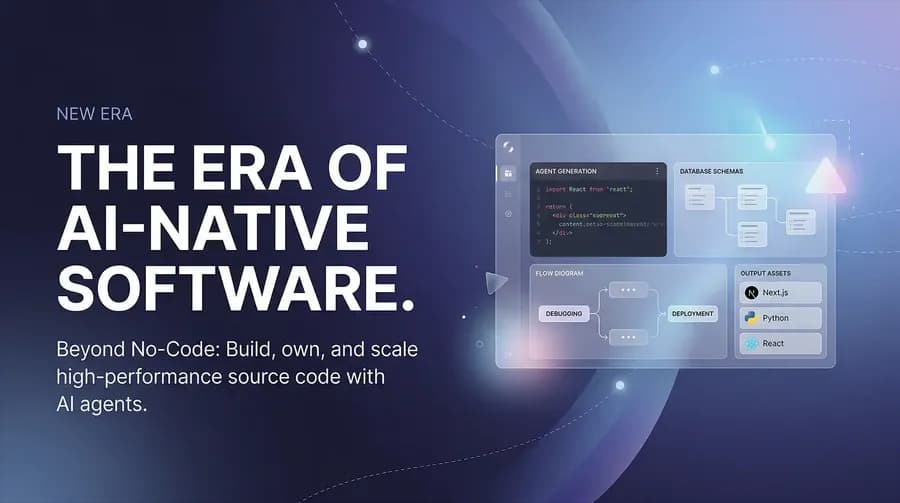
At its core,AI-native software developmentis the shift from \'Writing\ to \'Architecting.'\ Instead of typing characters, you interact with an \'Agentic IDE\ (Integrated Development Environment). You describe the feature, the database structure, and the user interface. The AI then handles the heavy lifting:
- Generation:Writing the boilerplate, the database schemas, and the complex logic.
- Debugging:Automatically running the code in a sandbox, identifying errors, and fixing them without human intervention.
- Deployment:Packaging the app and pushing it to production on industrial-scale platforms like Vercel, AWS, or GCP.
The One-Person Unicorn: Scaling a Software Agency Alone
The dream of theone-person unicorn—a $1B valuation with a team of one—is becoming a reality. In 2026, solopreneurs are launching and managing massive software portfolios using \'Agentic Maintainers.'\
These are AI agents that monitor your apps 24/7, identify performance bottlenecks, and ship bug fixes while you sleep. The need for a 10-person dev team to maintain a simple SaaS product is effectively over. This allows founders to focus on what matters: market fit, customer acquisition, and strategy.
The AI-First SDLC: From Idea to Production in 48 Hours
The traditional Software Development Life Cycle (SDLC) used to take months of planning and sprints. Today, anAI-first SDLChappens in a single weekend.
- Day 1:Use an AI strategist to map the market gap and user flow.
- Day 2:Use an Agentic IDE to build the MVP, run automated security audits, and generate unit tests.
- Day 3:Deploy and start marketing.
This speed isnt just about efficiency; its about the ability to fail fast and pivot. In 2026, the winner is no longer the person who writes the cleanest code, but the one who ships the most experiments.
Why You MUST Own Your Source Code in 2026
If you want tobuild an app with AI in 2026, don't settle for a drag-and-drop builder. Ownership is your ultimate asset. When your AI agent generates high-quality source code, you have a portable, fundable, and scalable asset. You arent just building a \'project\''; you are building a software empire.
Full ownership means you can hire a human developer later to add a \'finishing touch,'\ or you can continue to use AI agents to scale your architecture to levels that used to require a massive engineering department.
Conclusion / CTA
The barrier to entry in the software world is no longer technical; it is imaginative. In 2026, the only difference between you and a tech giant is the quality of your ideas and your ability to orchestrate the AI that builds them.
Are you ready to become a Sovereign Founder?Download our\'AI-Native Startup Blueprint\at Zero To AI and learn how to launch your first software product in under 48 hours.
FAQ (People Also Ask)
- Is AI-native coding better than no-code?Yes, because you own the actual source code and have no vendor lock-in.
- Do I need to know any programming?Knowing thelogicof programming is helpful, but you do not need to write the syntax yourself.
- What is a \'One-Person Unicorn\?A business started by a single founder that leverages AI agents to reach massive scale and valuation without traditional hiring.
Learn to build AI workflows that handle your busywork — live sessions, real projects, zero code.
See the courseBeginner-friendly