.jpg&w=1080&q=75)

Claude 4.6 & Effort Controls: Anthropics New Strategy for Developer Efficiency

Claude 4.6 & Effort Controls: Anthropics New Strategy for Developer Efficiency
Fine-tune intelligence, speed, and cost with a single toggle.
On March 26, 2026, Anthropic delivered a surprise update that has set the developer community ablaze. With the release of theClaude 4.6 series—including updated versions of bothOpusandSonnet—the company has introduced a game-changing feature calledEffort Controls.
Anthropics Surprise Release: Claude 4.6 Opus and Sonnet
While the industry expected a long wait for the next iteration of Claude, Anthropic has instead focused on a mid-cycle enhancement of its 4.0 models. The 4.6 update doesnt just improve baseline reasoning; it adds a layer of manual control that developers have been asking for since the first days of LLM integration.
What are Effort Controls and Why Should Developers Care?
Up until now, using an LLM meant accepting a fixed balance of speed, cost, and intelligence. If you wanted the smartest answer, you had to wait for it (and pay for it). If you wanted a fast answer, you often had to settle for a dumber model.
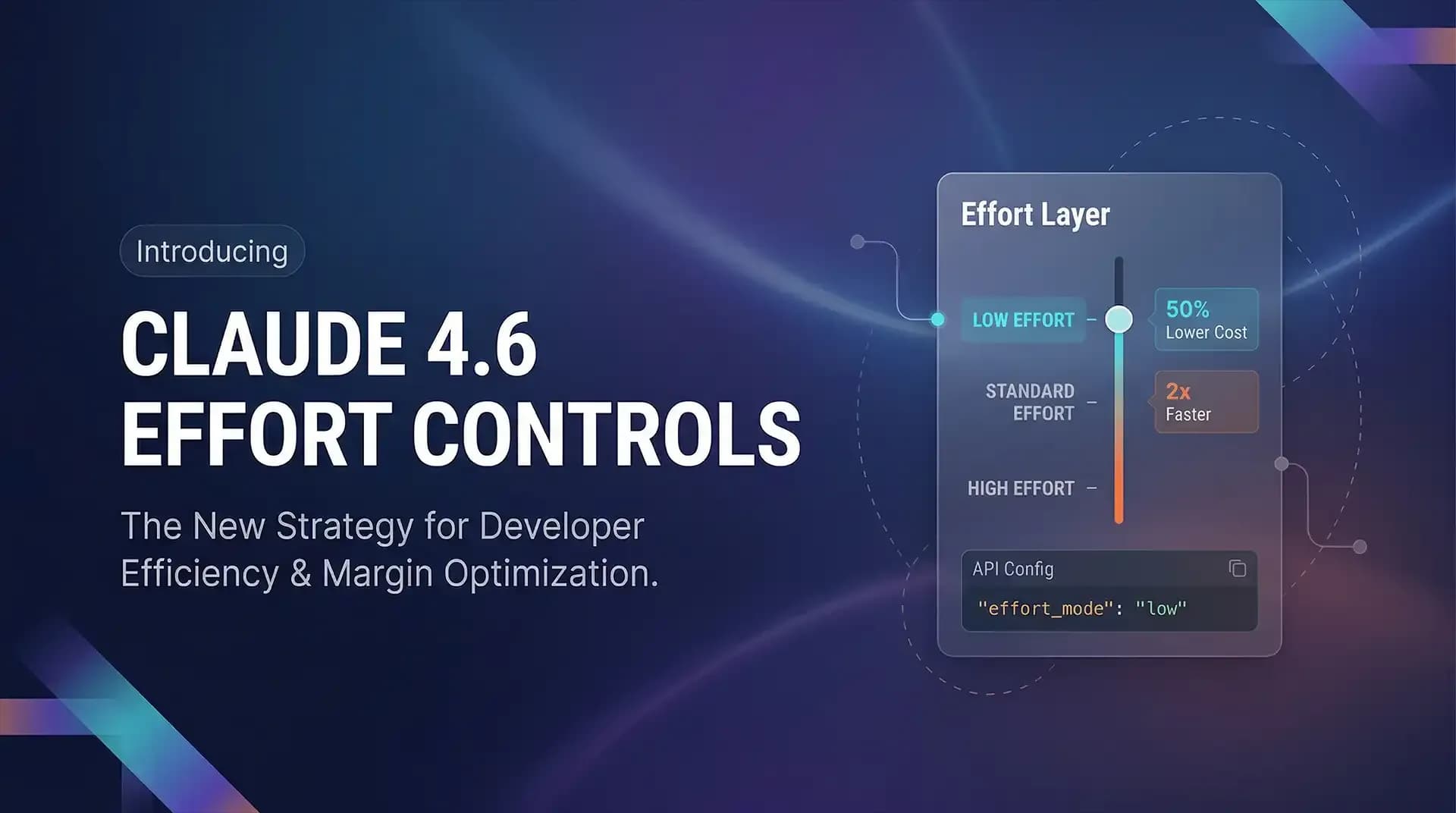
WithEffort Controls, Anthropic is giving you the granular ability to decide how much compute effort Claude should exert on a per-request basis. You can now tell the model to think deeply on a complex coding task or reply quickly to a simple customer service query using thes'amemodel architecture.
Cost vs. Performance: Optimizing Your SaaS Margins with One Toggle
For theZero to AIaudience—many of whom are building their own SaaS tools—this is a direct win for your bottom line.
Instead of switching between Opus (Expensive/Smart) and Sonnet (Cheap/Fast), you can use the more capable Opus 4.6 and simply dial down the effort for low-priority tasks. This allows you to maintain a consistent API architecture while optimizing your costs in real-time based on the users input.
In some tests, this toggle has shown more than a 40% reduction in total token costs for simple tasks.
New Agentic Features: Claude Cowork for OS X Integration
Beyond the API, Anthropic also launchedClaude Cowork for OS X. This is a dedicated desktop application that brings ambient agentic capabilities to your everyday knowledge work.
Claude Cowork doesnt just sit in a chat box; it understands your active window context, can help summarize emails, and even draft documents based on whats currently on your screen. This represents the next stage of human-AI collaboration where the AI is a co-pilot that is always aware of your work in progress.
How This Beats GPT-5.4s Strategy for Control
While OpenAIs GPT-5.4 focuses on Universal Computer Use, Anthropic is doubling down on Deep Workflow Control.
OpenAI wants the AI toa'ctlike a human on the computer; Anthropic wants to give the human totalcontrolover the AIs internal reasoning effort. For developers, this predictability and granularity are often more valuable than raw, uncontrolled power.
Learn to build AI workflows that handle your busywork — live sessions, real projects, zero code.
See the courseBeginner-friendly