.jpg&w=1080&q=75)

Cognitive Density Over Model Size: Why Smaller AI Models Are Winning in 2026

For three years, the AI industry had a simple formula: bigger model equals better results. That era is over.
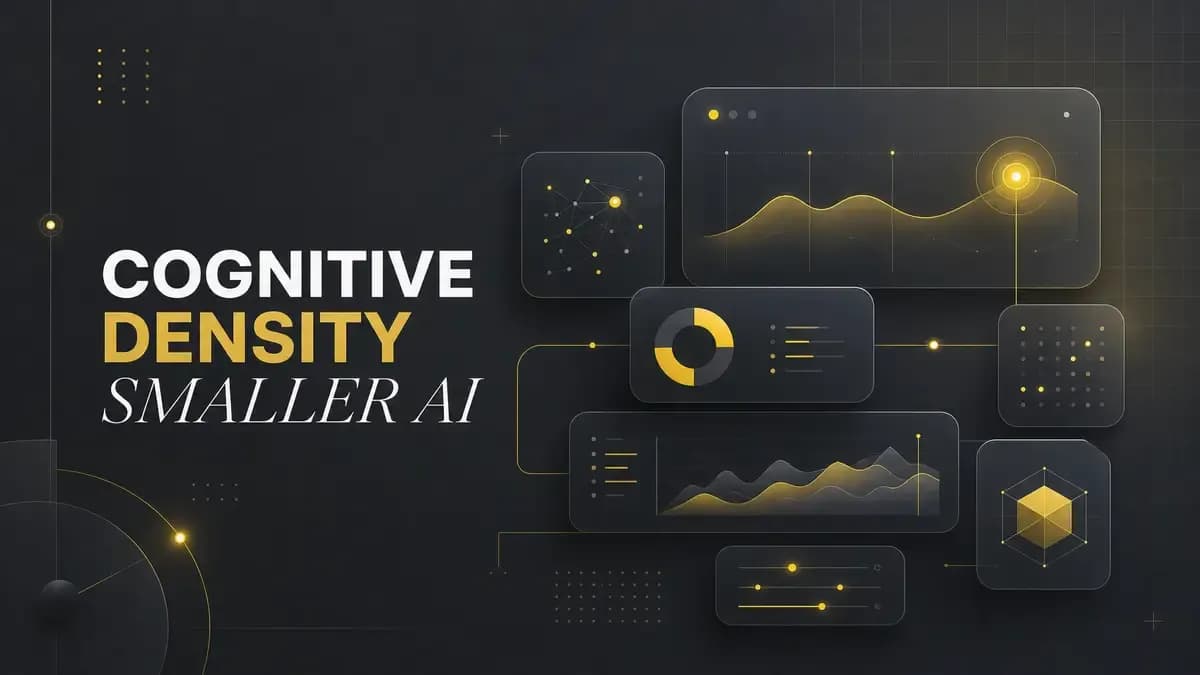
In 2026, the winning metric isnt how many parameters your model has. Its cognitive density—how much reasoning capability you can pack into each parameter, each dollar of compute, each millisecond of inference time.
What Is Cognitive Density?
Cognitive density is the ratio of useful reasoning capability to computational cost. A model with high cognitive density produces better outputs while consuming fewer resources. Low cognitive density: a 1 trillion parameter model that takes 30 seconds and costs $0.15 per query. High cognitive density: a 70 billion parameter model that takes 2 seconds and costs $0.01 per query. Same output quality. 15x faster. 15x cheaper.
Why the Shift Happened
The training data wall (we ran out of unique, high-quality text data), inference costs became the bottleneck (ongoing costs scale linearly with usage), edge deployment demand (enterprise customers need local models), and breakthroughs in compression (TurboQuant and knowledge distillation).
The Techniques Driving Cognitive Density
Knowledge Distillation: A large teacher model trains a smaller student model. Result: a 7B model that captures 95% of a 70B models reasoning at 1/10th the cost.
Quantization (TurboQuant): Reducing model weight precision from 32-bit to 8-bit, 4-bit, or even 2-bit. Googles TurboQuant applies different precision levels to different layers.
Architecture Innovation: Mixture of Experts (MoE) only activates a subset of parameters per query. A 100B parameter MoE model might only use 20B per inference.
Specialized Fine-tuning: A 3B parameter model fine-tuned on legal documents outperforms a 70B generalist on legal tasks.
The Practical Impact for Agent Builders
Cost Reduction: Replace non-critical agents with high-density small models to cut API costs by 80%. Speed: Smaller models equal faster inference across chained model calls. Privacy and Self-Hosting: High-density small models run locally on modest hardware. Resilience: No dependency on a single frontier model API.
The Model Selection Matrix for 2026
Simple tasks (classification, extraction) use small models (3-7B, self-hosted). Medium tasks use mid-size models (13-30B). Complex tasks use frontier models (Claude Opus, GPT-5). Multi-agent pipelines mix all three.
The key insight: you dont need a frontier model for every task. The smartest agent architectures use the cheapest model that produces acceptable output for each step.
The era of only companies with billion-dollar compute budgets can do AI is ending. The era of anyone with a good idea and a decent laptop can build an AI agent is beginning. Thats not just a technical shift. Its a democratization of intelligence.
Learn to build AI workflows that handle your busywork — live sessions, real projects, zero code.
See the courseBeginner-friendly