.jpg&w=1080&q=75)

Google’s TurboQuant: The End of Memory Bottlenecks for Local LLMs?

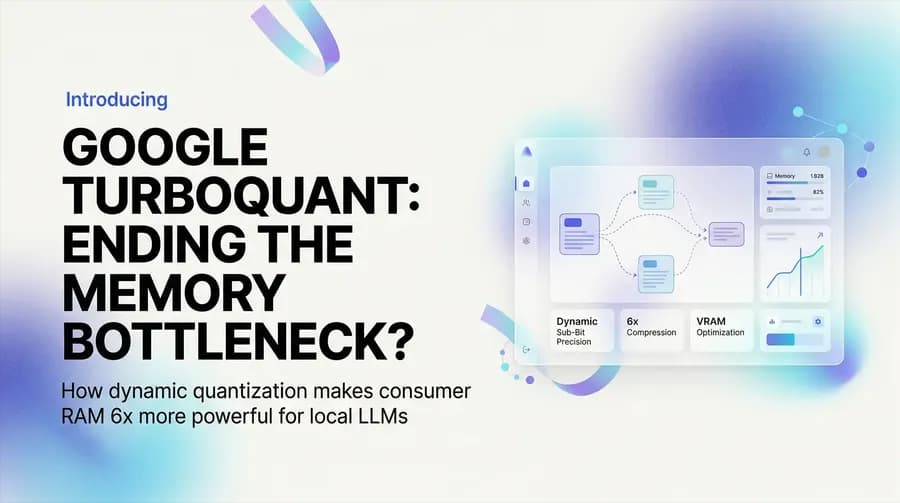
Google’s TurboQuant: The End of Memory Bottlenecks for Local LLMs?
How a single Google breakthrough just made your 8GB laptop RAM 6x more powerful for AI.
For the last three years, the biggest barrier to entry for local AI wasnt just processing speed—it was the Memory Wall. To run a high-quality, large language model (LLM) locally, you needed dozens of gigabytes of expensive VRAM. If you didnt have a $4,000 GPU, you were stuck in the cloud.
That changed on March 26, 2026.
What is Google TurboQuant? (The 2026 Quantization Leap)
Googles hardware division just unveiledTurboQuant, a new AI-first chip architecture and quantization protocol that reduces the memory footprint of large models by a staggering 6x without a noticeable drop in reasoning performance.
While 4-bit and 8-bit quantization have been the standard since 2023, TurboQuant uses Dynamic Sub-Bit Precision to allocate bits only where they matter most in a neural network. The result? A model that used to require 48GB of VRAM can now run on just 8GB of standard unified memory.
Why Memory Bottlenecks Kill Local AI (and How TurboQuant Fixes It)
The Memory Bottleneck occurs because moving data from your storage or standard RAM to your AI processor is much slower than the processor can actually work. In the past, trillion-parameter models were cloud-only because the sheer size of their weights couldnt fit into the high-speed cache of consumer devices.
TurboQuants 6:1 compression ratio effectively shrinks the data transfer, allowing the processor to stay fed with data even on standard consumer hardware.
The 6x Factor: Scaling LLMs to Your Spare Laptop RAM
For theZero to AIcommunity, this is the most important development of the decade.
- Before TurboQuant: Running a Llama-4 or Gemini-level model required a high-end workstation.
- After TurboQuant: Your 2024-era Macbook Air with 16GB of RAM is suddenly capable of running models that previously required an entire server rack.
This demolishes the GPU Tax that has kept small builders and solopreneurs from owning their own private, high-powered intelligence.
Market Reaction: Why Memory Stocks Tumbled on March 26
The market reaction was immediate and violent. Shares ofSK Hynix, Samsung, and Micronexperienced a significant tumble today. Investors are realizing that the demand for massive RAM stacks might decrease if software-level hardware breakthroughs like TurboQuant become the new standard.
We are moving from an era of brute force hardware to architecture-smart AI.
Future of Local AI: What This Means for Solo Developers
As a solo developer or business owner, what does this mean for you?
- Total Privacy: You can now run a world-class model on your own local device with zero data leaving your office.
- Zero API Costs: No more monthly tokens or pay-per-prompt overhead.
- Real-Time Speed: Local processing means zero latency from cloud round-trips.
The entry barrier to high-end AI has collapsed. The hardware you own right now is likely powerful enough to run the crown jewels of the AI world.
Learn to build AI workflows that handle your busywork — live sessions, real projects, zero code.
See the courseBeginner-friendly