.jpg&w=1080&q=75)
How Indian Agencies and Solopreneurs Build a No-Code AI Brand Memory & Review Workflow in 2026

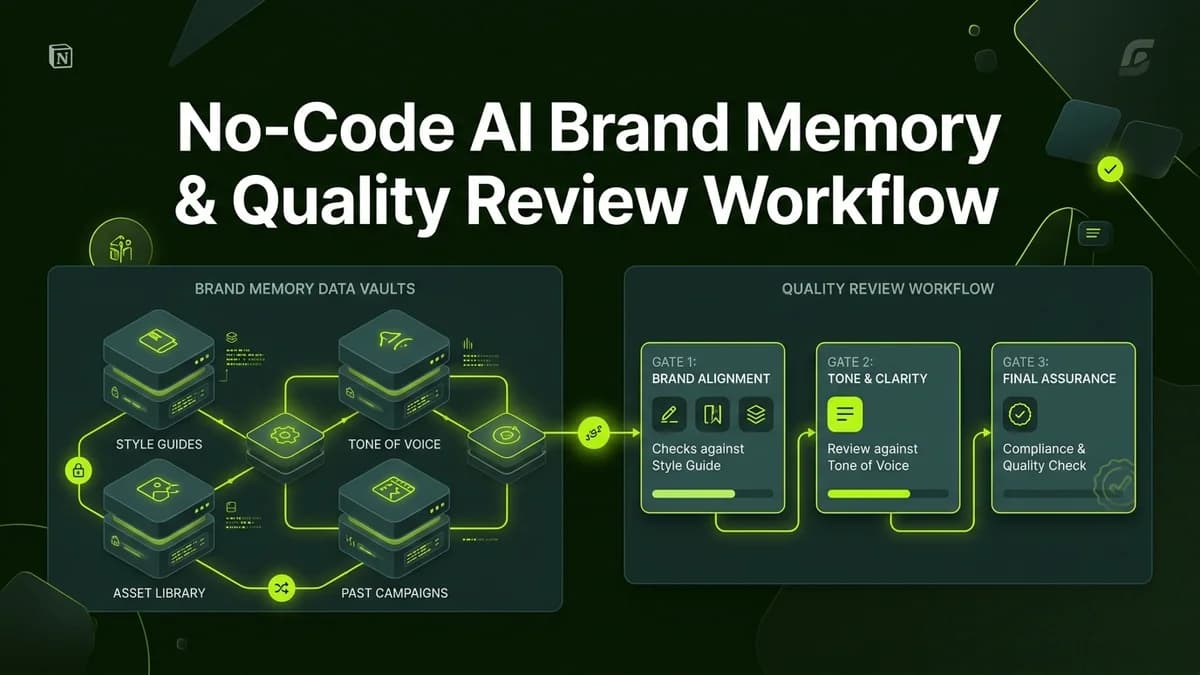
Non-technical teams eliminate off-brand AI content by building a central brand memory layer and multi-tiered quality review workflow using affordable no-code tools like Claude Projects, custom GPTs, and n8n.
Generative AI allows solopreneurs, digital marketers, and agency founders to draft marketing assets in seconds. However, scaling content production without a structured quality review system quickly floods digital channels with generic, off-brand material often referred to as AI slop. When AI tools operate without persistent memory, every new prompt resets to statistical averages, diluting brand identity and damaging audience trust.
Building a dedicated brand memory layer combined with a tiered review workflow ensures every AI-generated graphic, client email, and ad copy aligns with established voice guidelines, visual standards, and compliance rules.
Why Raw AI Outputs Fail to Stay On-Brand for Small Businesses
Off-the-shelf AI models are trained on massive public datasets to produce broadly acceptable responses. Without explicit brand guardrails, foundational models fill knowledge gaps using average internet patterns, resulting in predictable visual tropes, clichéd phrasing, and uninspired marketing messages.
Failure Point | Traditional Manual Workflow | Generic AI Tool Workflow | Brand Memory & Review Workflow |
|---|---|---|---|
Brand Consistency | High manual effort, limited by human speed | Inconsistent, resets context between prompts | High consistency via persistent custom brand memory |
Review Bottlenecks | Delays occur during asset creation | Delays pile up during manual QA and edits | Tiered review gates speed up low-risk approvals |
Error Modes | Typographic or copy-paste mistakes | Plausible hallucinations and generic phrasing | Automated compliance checks catch facts early |
Scalability Cost | Linear cost growth per new team member | Low generation cost, high hidden editing cost | Scalable output under ₹2,000/month using no-code |
The Productivity Paradox of Ungoverned AI Content
When team members spend hours correcting generic AI copy or fixing inconsistent visual assets, theoretical speed gains evaporate. Instead of accelerating output, ungoverned AI creates an editing bottleneck where senior marketers spend more time fixing low-quality drafts than executing high-value strategic work.
The Cost of Brand Dilution and Loss of Audience Trust
Audiences in 2026 are increasingly sensitive to automated, low-effort marketing. Publishing off-brand or formulaic content signals a lack of care, lowering engagement rates and reducing conversion efficiency across organic search and paid ad channels. Distinctive brand identity remains the primary driver of customer acquisition and long-term retention.
Step-by-Step Guide to Building a No-Code AI Brand Memory Layer
A brand memory layer acts as a centralized knowledge vault that feeds core guidelines, historical preferences, and past performance data directly into AI prompt workflows.
1. Document Implicit Voice and Visual Guidelines into Machine-Readable Artifacts
Static PDFs sitting in cloud folders are rarely read by AI prompt tools. Translate existing brand standards into clean, structured Markdown text files containing:
- Tone and Vocabulary Limits: Explicit lists of preferred industry terms, forbidden buzzwords, and sentence length preferences.
- Visual Hierarchy Rules: Exact hex color codes, typography pairings, padding specifications, and logo usage constraints.
- Target Persona Context: Detailed pain points, demographic details, and buying triggers for Indian SMBs and solopreneurs.
2. Configure Persistent Custom GPTs and Claude Projects
Platforms like ChatGPT Team and Claude for Work allow teams to upload brand reference files directly into persistent workspace containers:
- Knowledge Uploads: Attach style guides, high-converting email templates, and past top-performing landing page copy.
- Custom System Instructions: Direct the AI to evaluate all generated text against stored guidelines before producing final responses.
- Team Workspace Sharing: Ensure every team member accesses the exact same trained model version without duplicating setups.
3. Connect Automated Webhook Workflows Using n8n or Make.com
For automated operations such as social post drafting or inbound inquiry handling, connect prompt pipelines to central database tables:
- Centralized Data Sources: Store brand assets in Google Sheets, Airtable, or Notion databases.
- Automated Context Injection: Use n8n or Make.com webhook nodes to pull relevant brand rules into prompt payloads dynamically before calling model APIs.
Implementing a 4-Tiered Creative Review Workflow
To prevent review bottlenecks while maintaining strict quality control, classify content into four distinct risk tiers based on audience visibility and regulatory impact.
+-----------------------------------------------------------------------------------+
|                            TIER 1: LOW RISK (Internal)                           |
|                      Single Self-Review Gate (Automated QA)                       |
+-----------------------------------------------------------------------------------+
|
v
+-----------------------------------------------------------------------------------+
|                          TIER 2: MEDIUM RISK (Social & Blog)                       |
|                       Dual Review: Creative & Brand Quality                       |
+-----------------------------------------------------------------------------------+
|
v
+-----------------------------------------------------------------------------------+
|                        TIER 3: HIGH RISK (Paid Ads & Email)                      |
|                  Triple Review: Brand, Legal & Strategic Approval                 |
+-----------------------------------------------------------------------------------+
|
v
+-----------------------------------------------------------------------------------+
|                       TIER 4: CRITICAL (Product & Finance)                        |
|                  Full Stakeholder Sign-Off & Audit Logging                       |
+-----------------------------------------------------------------------------------+
Tier 1: Low-Risk Internal Content (Automated Checkpoint)
Internal team updates, meeting summaries, and draft outlines require minimal review. A single automated check verifying formatting and clarity is sufficient before distribution.
Tier 2: Medium-Risk Public Content (Dual Quality Check)
Standard social media posts, routine blog updates, and newsletter snippets undergo a two-step review:
- Craft Review: Verifies clarity, hook strength, and formatting consistency.
- Brand Review: Confirms adherence to visual color palettes and brand voice guidelines.
Tier 3: High-Risk Campaign Content (Triple Approval Gate)
Paid ad creative, cold outreach sequences, and sponsored content require sequential sign-offs across creative execution, brand fidelity, and factual accuracy checks.
Tier 4: Critical Compliance Content (Full Stakeholder Audit Log)
Product claim announcements, financial documentation, and client contracts demand formal human-in-the-loop sign-off recorded in a clear audit trail.
Essential Quality Control Checklist for AI Content Reviews
Before approving any AI-assisted asset for publication on Zero To AI or client channels, run through this practical quality control checklist:
- Factual Verification: Has every stat, claim, link, and pricing figure been independently verified by a human team member?
- Tone & Voice Alignment: Does the writing reflect conversational, professional language without robotic transition words?
- Visual Consistency: Do image dimensions match required 16:9 or 9:16 aspect ratios using flat solid colors (#152805 background, #a2dc05 accents)?
- Originality Check: Is the output free from formulaic AI intro structures and generic stock imagery tropes?
- Clear Call to Action: Does the content deliver pure educational value while guiding readers to logical next steps?
Frequently Asked Questions (PAA)
Why does generic AI content look and sound off-brand?
Generic AI models rely on average internet datasets to construct outputs. Without persistent brand memory or custom system instructions, tools default to cliché phrasing and generic visual styles that fail to reflect specific brand guidelines.
Can better prompt engineering fix off-brand AI outputs?
Prompt engineering helps improve individual outputs, but it cannot solve systemic inconsistency across teams. Without a central brand memory layer and persistent custom models, every user must re-enter context manually, leading to variable quality.
How much does it cost to build a no-code brand memory workflow?
Non-technical Indian solopreneurs and small agency owners can implement a complete brand memory and review pipeline for under ₹2,000/month using standard ChatGPT Team, Claude Projects, and free-tier n8n automation setups.
What is the role of human-in-the-loop oversight in AI workflows?
Human oversight ensures brand judgment, cultural nuance, and factual accuracy remain intact. While AI handles rapid drafting and format conversions, trained humans hold final accountability for approving public-facing content.

Learn to build AI workflows that handle your busywork — live sessions, real projects, zero code.
See the courseBeginner-friendly