.jpg&w=1080&q=75)

Luma AI Uni-1: The Image Model That Just Beat Google & OpenAI

Luma AI Uni-1: The Image Model That Just Beat Google & OpenAI
On March 24, 2026, a startup best known for video generation quietly dropped the most disruptive image model of the year. Luma AIsUni-1didnt just enter the AI image generation race — it redefined the rules.
While everyone was watching OpenAI and Google fight for benchmark supremacy, Luma built something fundamentally different: the first image model thatthinks before it draws. And the results are hard to argue with.
What Is Luma AI Uni-1 and Why Does It Matter?
Uni-1 is a unified understanding and generation model — and thats not just marketing language. It describes a genuinely different architecture from anything thats come before in mainstream image generation.
Most AI image generators work like this: you give them a prompt, they generate pixels. They dontunderstandwhat theyre building. They pattern-match against training data and produce something plausible.
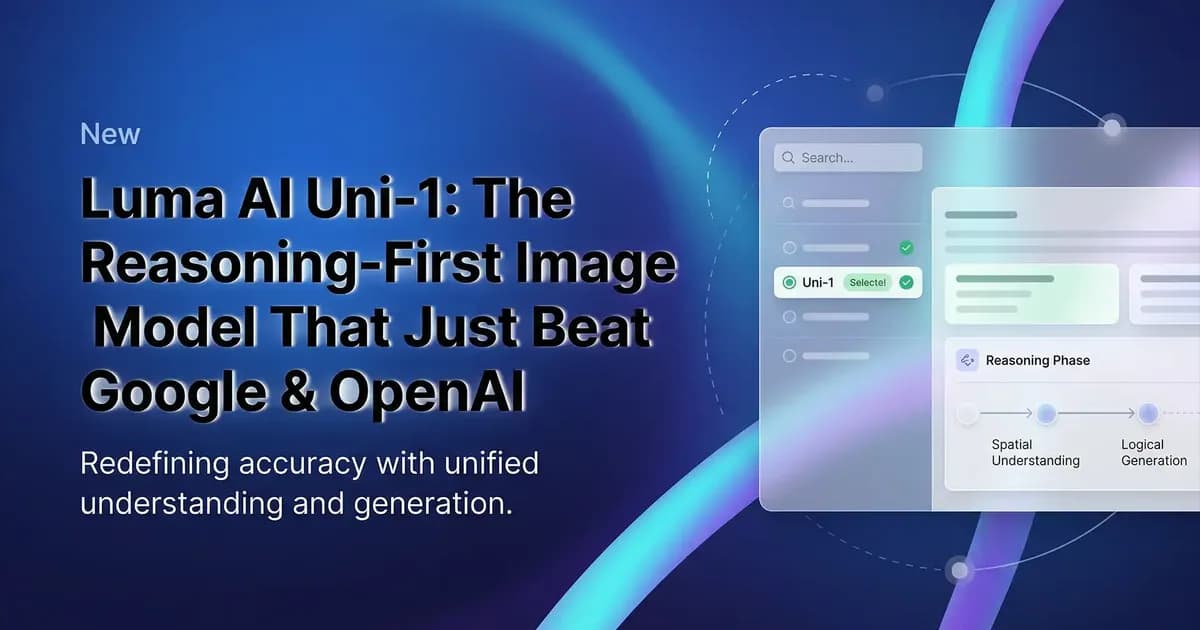
Uni-1 works differently. Before generating a single pixel, it runs achain-of-thought reasoning phase. It asks itself: What should this image contain? How should the spatial relationships work? Whats the logical sequence of visual elements here?
This is the same token-by-token prediction method that powers large language models like Claude and ChatGPT — applied to image generation for the first time in a production model. The result is an image model that can handle tasks requiring logic, causality, and spatial reasoning — not just style matching.
The Benchmarks: Where Uni-1 Actually Wins
On the RISEBench — the Reasoning-Informed Visual Editing benchmark — Uni-1s performance is remarkable:
- Tops Google Nano Banana 2across all four reasoning dimensions: temporal, causal, spatial, and logical
- Outperforms OpenAI GPT Image 1.5on every reasoning-based task category
- Nearly matches Google Gemini 3 Proon object detection
- Achieves this at10–30% lower costat high resolution
At 2K resolution, Uni-1 costs approximately $0.09 per image via API. Compare that to $0.101 for Googles Nano Banana 2 and $0.134 for Nano Banana Pro. For high-volume workflows — AI art businesses, content agencies, product design — that cost difference adds up to thousands of dollars per year.
Enterprise brands including Adidas, Mazda, and Publicis Groupe are already using Luma AIs tools in production. Thats a strong signal.
How Uni-1 Compares to Midjourney and DALL-E
Heres the honest comparison most tech coverage skips.
Midjourneyexcels at aesthetic quality. If you want a stunning, painterly image with gorgeous lighting and texture, Midjourney is still the best option. But it struggles when your prompt requires logical consistency — objects in the right positions, scenes that follow cause and effect, text that renders accurately.
DALL-E / GPT Image 1.5is versatile and tightly integrated into the ChatGPT ecosystem. Useful for quick generation, but its reasoning during generation is limited.
Uni-1fills a genuine gap: use cases that requirecorrectness over beauty. Product mockups, instructional visuals, infographics, scenes that need to follow a logical sequence, or any brief where close enough creates real problems.
Key insight: Uni-1 isnt competing to be the most beautiful image model. Its competing to be the mostaccuracyone — and in professional and commercial use cases, accuracy often matters more.
What This Means If You Use AI to Earn Money
For Zero to AI learners, this isnt just an interesting benchmark story. Its a new income opportunity with a lower cost floor.
Print-on-demand businessesare one of the most accessible AI income models. You sell AI-generated designs on physical products through platforms like Printify or Redbubble — no inventory, no shipping. The challenge has always been consistency: getting AI to follow precise spatial rules reliably. Uni-1s reasoning architecture handles this significantly better.
Content agenciesusing AI imagery for blogs, social posts, and ads now have a cheaper, more reliable option for images that need factual accuracy — the right number of objects, correct spatial layouts, labels that make sense.
Freelance designerswho use AI to accelerate production can take on more complex client briefs — the kind that require logical precision in the output, not just aesthetics.
The cost reduction alone (10–30% vs. comparable models) means more margin on every deliverable you sell.
How to Try Uni-1 Right Now
You can test Uni-1 free at [lumalabs.ai/uni-1]'(https:/'/lumalabs.ai/uni-1) through their web interface — no signup required to explore.
API access starts at $0.09 per image at 2K resolution. Uni-1 is also available through aggregator APIs like CometAPI if youre building workflows that compare outputs across multiple models.
For beginners, the best first step is to take a prompt that requires logical consistency — something like a room with a desk on the left, a bookshelf on the right, and a window behind the chair — and run it through Uni-1 alongside Midjourney or DALL-E. The difference in spatial accuracy will be immediately visible.
The Bottom Line
Luma AI Uni-1 is the first production image model that reasons about what its creating before it creates it. It outperforms Google and OpenAI on logic-based benchmarks at a lower cost per image — and its available right now.
For AI learners building income streams, the tools just got better and cheaper again. Thats the defining pattern of 2026. The barrier keeps dropping. The question is whether youre building while it does.
Want to turn AI image generation into income? Read our guide: [7 Real Ways to Make Money With AI in 2026]'(/how-to-make-money-with-ai-2026).
Frequently Asked Questions
What is Luma AI Uni-1?
Uni-1 is an AI image generation model from Luma AI that uses a reasoning-first architecture. Before generating any image, it runs a chain-of-thought planning phase — making it significantly better at images requiring logical consistency, spatial accuracy, and cause-and-effect relationships.
How does Uni-1 compare to DALL-E and Midjourney?
Uni-1 outperforms OpenAIs GPT Image 1.5 and Googles Nano Banana 2 on reasoning benchmarks. Its not designed to replace Midjourney for pure aesthetic tasks, but it excels where precision and logical correctness matter more than artistic style.
How much does Luma AI Uni-1 cost?
API access is priced at approximately $0.09 per image at 2K resolution — 10–30% cheaper than comparable Google models.
Can I use Uni-1 to make money with AI?
Yes. Uni-1 is well-suited for print-on-demand design, content agency work, product mockups, and any freelance design use case requiring logically consistent images at scale and lower cost.
Learn to build AI workflows that handle your busywork — live sessions, real projects, zero code.
See the courseBeginner-friendly