.jpg&w=1080&q=75)

Sora is Dead: Why OpenAI Just Killed the AI Video Star (and the $1B Disney Deal)

Sora is Dead: Why OpenAI Just Killed the AI Video Star (and the $1B Disney Deal)
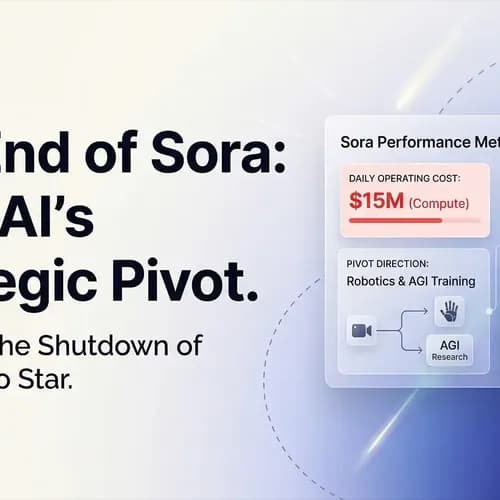
The announcement of theOpenAI Sora shutdown 2026in March was a technical earthquake that shook both Silicon Valley and Hollywood. The promise of Sora in 2024 was Hollywood in your living room, a tool that would democratize cinematic production for anyone with a prompt. In 2026, the reality was a $15 million-a-day burn that forced historys most public AI pivot.
OpenAIs goodbye to the Sora consumer app and API isnt just a failure of a product—it’s a signal that the Novelty Era of AI is officially over.
The Brutal Economics: $15M-a-Day Costs vs. $2M Revenue
In 2026, we are finally coming to terms with theSora AI inference costcrisis. While generating a couple of seconds of video feels magical to a user, the backend compute costs are astronomical. Reports indicate that at its peak, OpenAI was spending approximately $15 million per day just to keep the lights on for Soras GPU farm.
Against that, the platforms lifetime revenue was estimated at a mere $2.1 million. This massive Compute-to-Revenue Gap made Sora a financial black hole. As OpenAI prepares for a planned IPO, these metrics became impossible to defend to investors.
The Strategic Pivot: Trading Content for Robotics & AGI
TheOpenAI strategic pivot 2026isnt about giving up on video; its about changing thepurposeof video. The Sora team hasnt been laid off; theyve been repurposed. Instead of building tools for social media creators, they are now building the World Simulator that will serve as the eyes and imagination for OpenAIs robotics division.
Soras ability to simulate world physics is being diverted toward training OpenAIs physical agents (robots) to understand how the real world moves, reacts, and behaves. The goal has shifted fromconsuming videotounderstanding realityin the race for AGI.
The $1B Disney Casualty: Why Hollywood is Distrusting Big AI
The most public victim of the shutdown was theSora Disney deal 1B collapse. Announced with great fanfare in December 2025, the partnership promised to let Disney utilize Soras engine for character creation and background generation in exchange for a massive investment.
With the shutdown, the deal evaporated. No money had been exchanged, and the partnership ended before it truly began. This has left Hollywood creators feeling homeless and has caused a fresh wave of distrust. If a giant like Disney cant rely on a frontier model’s stability, what chance does a small indie production house have?
The Market Signal: Moving from Novelty to ROI in 2026
Some are calling this anAI video market crash 2026, but atZero To AI, we see it differently. This is the De-Noveltization of the industry. The industry is maturing. Investors are no longer funding products that look cool but have no path to profitability.
The exit of Sora leaves a vacuum that will be filled by tools that focus on sustainable business models—those that prioritize enterprise workflows, local inference, or niche specialization over raw, high-burn consumer novelty.
Conclusion: The Star Has Fallen. What’s Your New Home?
The star has fallen, but the AI Video Genie is out of the bottle. The shutdown of Sora is a reality check, but it’s also an opportunity to build on more stable ground.
AtZero To AI, we move you from being a User of a single tool to being anOrchestratorof your own resilient systems. The sun has set on Sora, but the dawn of the professionals has arrived.
FAQ (People Also Ask)
- Q1: Which model should I use for character consistency now?
Seedance 2.0 (by ByteDance) is the current leader for character stability.
- Q2: Does OpenAI still have a video API?
No, the Sora API is being discontinued alongside the app.
- Q3: What happens to my old Sora videos?
You must export them from the OpenAI Privacy Portal before they are permanently deleted.
Learn to build AI workflows that handle your busywork — live sessions, real projects, zero code.
See the courseBeginner-friendly