.jpg&w=1080&q=75)

RAG vs. Fine-Tuning: How to Ground Your Business Data in 2026

RAG vs. Fine-Tuning: How to Ground Your Business Data in 2026
AI that truly knows you.
The biggest challenge in 2026 isnt making AI smart—its making itfactual. If youve ever used a general-purpose model like GPT or Claude for your business, youve probably encountered its Hallucination problem: it can confidently tell you something about your own company that is completely false.
To fix this, there are two primary methods:Fine-TuningandRAG (Retrieval-Augmented Generation).In this guide, we’ll explain which one you should choose for your Zero to AI journey.
The Hallucination Problem: Why General LLMs Cant Trust Your Data
General-purpose models are trained on the entire internet'—not your companys internal PDFs, specific customer emails, or proprietary processes.
When you ask an AI What is our companys refund policy?, its essentiallyguessingbased on general refund policies it saw during its training. To get it to knowyourspecific policy, you have to provide it with context.
Fine-Tuning: The Static Brain (When and Why to Use It)
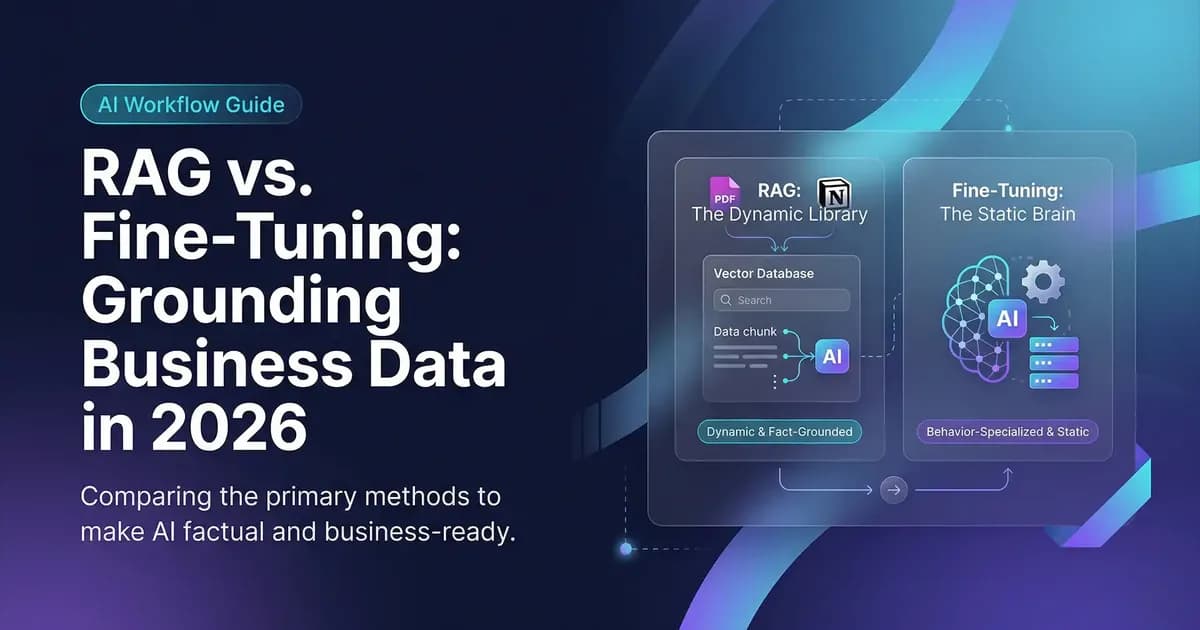
Fine-Tuning is the process of training a smaller version of an LLM on your specific dataset. Think of it as teaching the brain new behaviors or a very specific style of speaking.
- Pr'os: The model becomes highly specialized in a particular voice or formatting style.
- Cons: It is Static. If your refund policy changes tomorrow, you have to re-train the model. Its also expensive and technically difficult to maintain for most solopreneurs.
RAG (Retrieval-Augmented Generation): The Dynamic Library
RAG is the Golden Standard for business data in 2026. Instead of trying to teach the AI everything, you give it a Searchable Library (a Vector Database) of your companys documents.
When you ask a question, the system firstretr'ievesthe relevant page from your library and then asks the AI togeneratean answer basedonlyon that page.
- Pr'os: It’s Dynamic. If you update a document in your library, the AI knows it immediately. It’s cheaper, faster, and much less likely to hallucinate.
- Cons: Requires a bit more initial setup in your automation stack (like n8n or Pinecone).
For Solopreneurs: Which Strategy Wins in 2026?
For the vast majority ofZero to AIreaders,RAG wins 95% of the time.
If youre building a customer support bot, a research assistant, or a personal knowledge brain, RAG is the superior choice. It allows you to ground your AI in Fact without the high cost and technical complexity of constant fine-tuning.
Fine-Tuning should be reserved for when you need a very specificbehavioralchange—like making an AI talk exactly like a specific persona or output a very complex data structure.
Building Your First RAG Pipeline: A 3-Step Overview
If youre ready to start building, here is the high-level roadmap:
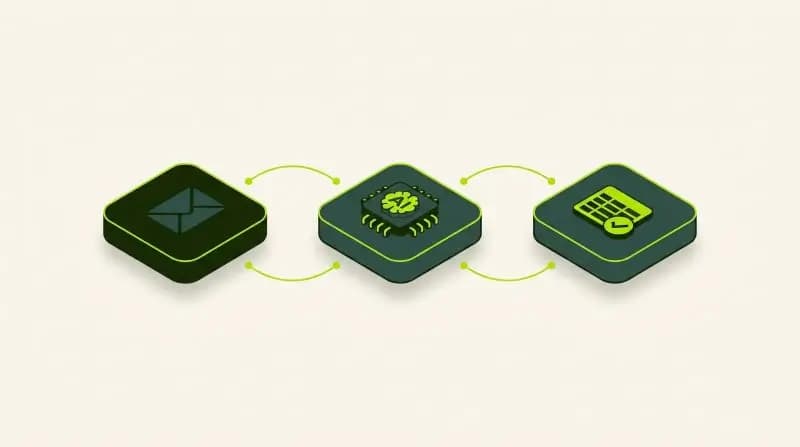
- Ingest: Collect your documents (PDFs, Notion pages, etc.) and convert them into small chunks.
- Em'bed: Use an Embedding Model to turn those chunks into a mathematical format that AI can understand.
- Retr'ieve: Connect your AI to a Vector Database (like Pinecone or Weaviate) so it can pull the right chunk when asked a question.
In 2026, the real value of AI is not just its Intelligence'—it’s how well that intelligence is grounded in your Reality.
Learn to build AI workflows that handle your busywork — live sessions, real projects, zero code.
See the courseBeginner-friendly