.jpg&w=1080&q=75)

Local LLMs in 2026: TurboQuant for Context-Rich Agents on a Budget

Local LLMs in 2026: TurboQuant for Context-Rich Agents on a Budget
The Lab is officially in your living room. In 2026, you dont need a $30,000 server or a massive enterprise cloud credit to run high-performance AI. The Local Revolution has arrived, and it’s being fueled by software efficiency, not just raw silicon.
With breakthroughs like TurboQuant, you can nowrun LLM on consumer GPU 2026models that were previously Enterprise Only.
The Democratization of Inference: Enterprise Algorithms for Everyone
For years, the best AI optimization was a trade secret of the Big Three cloud providers. But in 2026, these algorithms are hitting the open-source community.
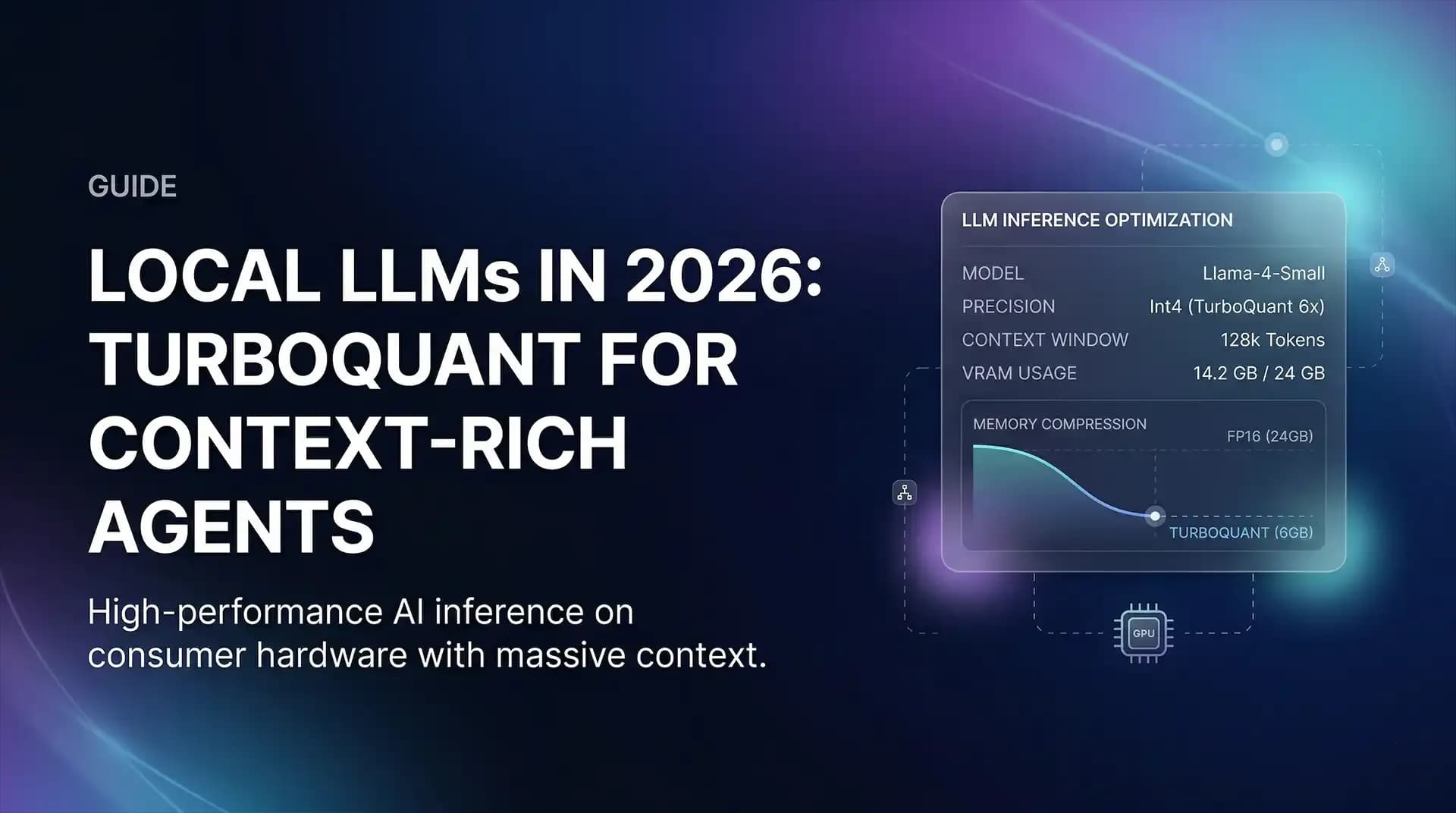
UsingTurboQuant consumer hardwarelogic, the Memory Wall that used to stop a consumer GPU at 32k tokens has been dismantled. By compressing the models working memory, your home PC can now handle 100k+ token contexts—large enough to digest an entire book or a complex software repo—on a single card.
Building Your 2026 AI Workstation: The Sweet Spot for VRAM
If you want torun LLM on consumer GPU 2026, theRTX 5090is the gold standard, but it’s no longer the only option. Thanks to 6x compression, 12GB and 16GB VRAM cards are back in the game.
- The Pro Choice (24GB VRAM): Can now handle 500k+ token contexts with TurboQuant.
- The Budget Hero (12-16GB VRAM): Perfect for running sophisticatedquantized high context modelslike Llama-4-Small or DeepSeek-V4.
- The Zero To AI Recommendation: Focus on memory bandwidth over raw core count. The Memory Wall is about bits, not hertz.
Context Scaling at Home: Your 1M Token Research Powerhouse
Imagine alocal AI agent scalingeffort where you feed your entire personal journal, or 50 research papers, into a local model. In the past, this would have crashed your system.
Today, with 6x compression, you can maintain Permanent Memory for your local assistant. This turns a simple chatbot into a high-level research partner that understands your history, your tone, and your specific project context—all while keeping your data 100% private on your own machine.
The Zero To AI Strategy: Mastering Permanent Memory Locally
AtZero To AI, we’ve developed a specificZero To AI workflowfor local agents:
- Selective Compression: Keep your System Prompt in high-precision and compress the user history.
- Tiered Cache Storage: Move old KV cache parts to system RAM while keeping the active part in VRAM.
- Local RAG Integration: Combine TurboQuant-style memory with local vector search for infinite context reach.
Conclusion: The Future is Local, Private, and Efficient
The era of being tethered to a cloud providers API limits is ending. By leveraging enterprise-grade optimization at home, you are no longer just a consumer—you are a creator with the power of a data center on your desk.
FAQ (People Also Ask)
- Q1: Which local inference engine supports TurboQuant?
Currently, SGLang and high-end vLLM configurations are leading support, with Ollama integration expected in Q3 2026.
- Q2: Does this mean I dont need a high VRAM GPU?
It means you can dom'orewith less, but more VRAM will always allow for larger, smarter models.
- Q3: Is local AI as safe as cloud AI?
Itssaferbecause your data never leaves your physical device.
Learn to build AI workflows that handle your busywork — live sessions, real projects, zero code.
See the courseBeginner-friendly