.jpg&w=1080&q=75)

Holographic Display UX: How to Design for the First Generation of Spatial OS Devices

Holographic Display UX: How to Design for the First Generation of Spatial OS Devices
The web is no longer a collection of flat rectangles. In March 2026, we are entering the era of theSpatial Multiverse OS.Devices from Apple, Meta, and the new spatial startups have turned the physical world into a canvas for digital interaction.
For designers, this is the first true paradigm shift since the iPhone. Moving from 2D screens to holographic space requires a fundamental rethink of every UX principle youve ever learned.
The Shift: Moving from 2D Rectangles to Multimodal 3D Interaction.
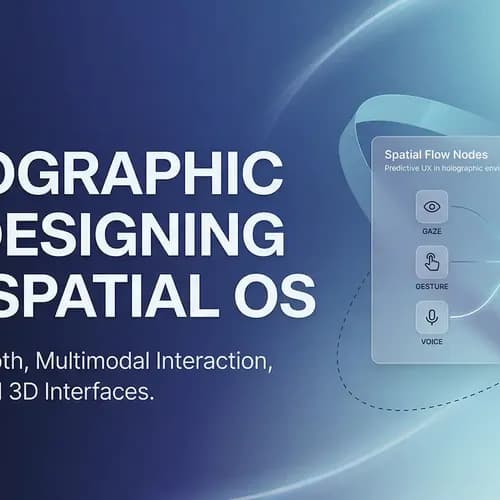
On a screen, up and down are fixed. In spatial design, the user is the center. Every interface sitswithintheir world. Interaction isnt just about clicks—its about gaze, gesture, and voice. This is the Multimodal era of design.
Principles: Applying the Functional Architect mindset to 3D space.
In spatial design, pretty is dangerous. An interface that follows you everywhere is an annoyance. An interface that blocks your view is a safety hazard. Functional design in 3D meanscontextual relevance.If the user is at home, their cooking interface appears; if they are in the office, their kanban board materializes.
Tools: Combining GPT-5.4 logic with Spline, Bezi, and visionOS SDKs.
Mastering the 2026 spatial stack:
- GPT-5.4 Native Code: For generating 3D physics and logic on the fly.
- Spline & Bezi: For real-time 3D collaboration and prototyping.
- Spatial Flow Nodes: Using AI to predict where a user will look and prepping the interface before they do.
Futureproofing: Why your next client wont ask for a Website, but for an Experience.
The most valuable digital real estate of 2026 isnt a domain name—its the holographic space around the user. Those who can design functional, useful experiences in this space will be the most highly-paid creative leaders of the next decade.
Conclusion: Start Designing in Depth.
Stop thinking in pixels. Start thinking in volumes. The transition to spatial design is happening now. Master the Depth Logic, and youll be the one building the interfaces of the future.
Learn to build AI workflows that handle your busywork — live sessions, real projects, zero code.
See the courseBeginner-friendly