.jpg&w=1080&q=75)

Systemic Thinking vs. Prompt Tinkering: Why 90% of Automations Fail Under Load

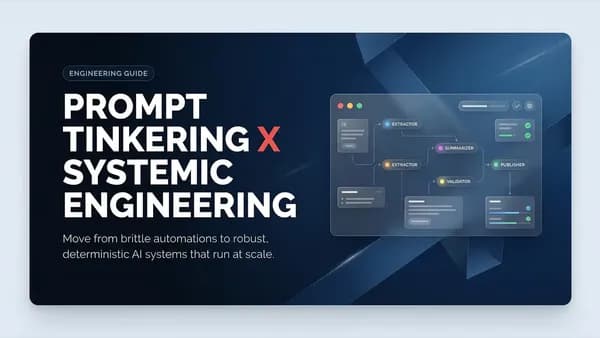
Systemic Thinking vs. Prompt Tinkering: Why 90% of Automations Fail Under Load
The Demo Magic of AI is a seductive liar.
You’ve seen it. You write a clever prompt for GPT-4o, and on the first try, it executes a complex task perfectly. You think,This is it. Ive just automated my entire operations department with 50 words.Then you hook that prompt into a production workflow in n8n or Zapier, and within 48 hours, it’s spitting out hallucinations, missing critical JSON keys, or failing entirely because someone sent an email with an attachment it didnt expect.
Welcome to theReliability Gap.
In 2026, the era of Prompt Engineering is dying. It’s being replaced bySystemic AI Engineering. If you want to scale a solo-business to seven figures using agents, you have to stop tinkering with adjectives in your prompts and start building deterministic systems.
The Fragility of the Perfect Prompt
Brittle prompts are the biggest hidden debt in AI companies today. When you rely solely on a LLM to figure it out based on a single prompt, you are building your business on shifting sand.
- Model Drift:OpenAI or Anthropic updates their models every few weeks. A prompt that worked on Monday might produce subtly different outputs by Friday.
- Edge Case Overload:A single prompt trying to handle classification, extraction, and drafting will eventually collapse when it encounters something it hasnt seen before.
- Lack of Determinism:If a system can’t give you the exact same result for the same input 99.9% of the time, it’s a toy, not a business tool.
The 3 Pillars of Systemic AI Automation
To move from an amateur tinkerer to a professional orchestrator, you must rebuild your AI logic around these three architectural pillars.
1. Modular Logic (Atomics)
Stop asking one agent to do everything. Break your workflow into atomic actions. Instead of a Newsletter Agent, build:
- An Extractor:Identifies URLs from an inbox.
- A Summarizer:Turns a URL into 3 bullet points.
- An Editor:Checks the tone and formatting.
- A Publisher:Formats the final HTML.
By modularizing, you can swap out the model for each step (e.g., use Claude for editing, but a cheaper model like Llama 3 for extraction).
2. Deterministic Guardrails
Dont let the LLM decide the structure of your data. UseJSON SchemaandRegExto force the output into a specific format. If the LLM returns anything other than a valid JSON object that matches your schema, the system shouldnt try to fix it'—it should trigger a failure branch or a retry loop.
3. Stateful State Management
A professional AI system needs memory that isnt just a chat history. It needs aState Store(like a database or a shared variable in n8n) that tracks exactly where a task is in its lifecycle. If the internet cuts out halfway through a 10-step process, your system should know exactly which step failed and resume from there—not start over and waste tokens.
Case Study: The Email Triage Collapse
Last year, a startup built a Zero-Touch Email Support system using a single master prompt. It worked for two months. Then, they received an email from a customer written in a mix of French and English with an embedded SQL query. The prompt got confused, tried to execute the query in its imagination, and accidentally sent the customer an internal system prompt instead of a helpful reply.
A systemic approach would have had aLanguage Detection Nodefollowed by aSecurity Scrubbing Nodebefore it ever reached the drafting agent.
2026 Best Practices for AI Orchestrators
- Version Control:Treat your prompts like code. If you change a sentence, it’s a new version.
- Auto-Evals:Build a Golden Dataset of 50 perfect examples. Every time you change your system, run it against these 50 examples to ensure you havent introduced regressions.
- Failure Branches:Every AI step in your workflow should have a What if this fails? branch. Never assume the API will be up or the output will be correct.
From Tinkerer to Engineer
The competitive advantage in 2026 isnt knowing how to talk to AI. That’s a commodity skill. The advantage belongs to those who can buildhardened, reliable systemsthat run while they sleep, without needing a human to babysit the logs.
Stop tinkering. Start engineering.
Learn to build AI workflows that handle your busywork — live sessions, real projects, zero code.
See the courseBeginner-friendly