.jpg&w=1080&q=75)

The Cost of Zero: Managing the Hidden Carbon and Compute Debt of Your AI Infrastructure

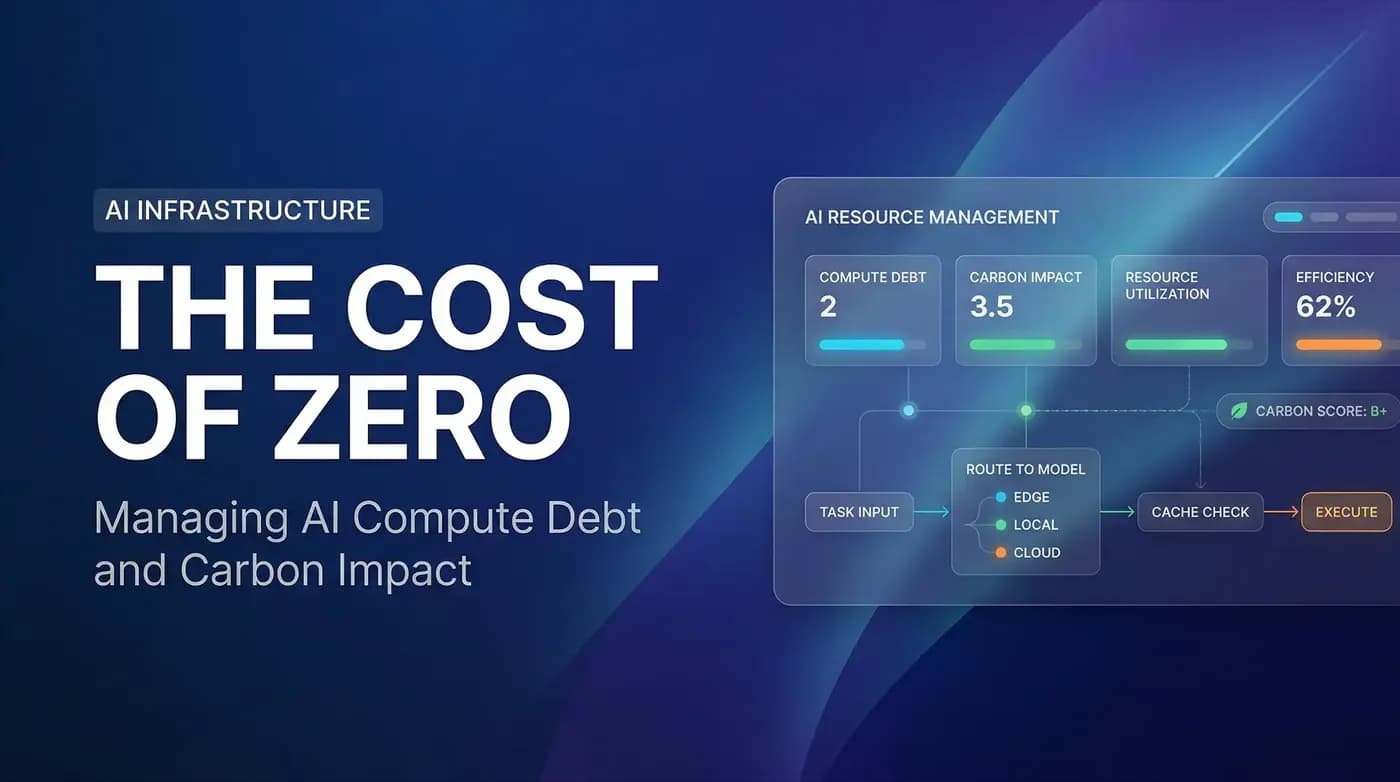
The Cost of Zero: Managing the Hidden Carbon and Compute Debt of Your AI Infrastructure
The dream of the one-person, ten-figure business is finally real in 2026. You sit back, press a button, and hire a fleet of digital agents to do the work of a hundred humans.
But here’s the reality nobody talks about in their morning newsletter:Zero Employee does not mean Zero Cost.
If youre scaling an autonomous business today, you arent just managing humans anymore. You are managingCompute DebtandCarbon Impact. If you dont get a handle on these two hidden costs, your solo-startup will eventually suffocate under its own operational weight.
The Zero Fallacy
When we talk about the Zero to AI journey, we focus on efficiency. But every time your agent pings an API, it’s not just costing you a fraction of a cent. It’s consuming high-performance compute cycles and electricity on a server farm in Oregon or Iowa.
As a solopreneur in 2026, you be no longer just a content creator or a strategist. You are aDigital Resource Manager.
What is Compute Debt?
Think ofCompute Debtlike technical debt for your AI. It happens when you build lazy automations.
- Lazy:Asking a 70B model to summarize a 2-paragraph email.
- Lazy:Running the same research prompt five times because you didnt build a caching layer.
- Lazy:Letting an agentic loop run indefinitely because you didnt set a hard stop on its reasoning steps.
Over time, this debt accumulates. You find yourself paying for thousands of redundant tokens and wasting millions of compute hours that contribute nothing to your bottom line.
The Energy Reality of 2026: Carbon-Aware Scheduling
In many parts of the world now, the Price per Token is being tied to local grid availability. The smartest solopreneurs are usingCarbon-Aware Scheduling.
- The Strategy:Run your heavy Research & Synthesis jobs at 2:00 AM when the local wind farm is over-producing and the grid is clean.
- The Payoff:A lower Carbon Intensity Score, which—as of this year—is becoming a mandatory disclosure for any solopreneur contracting with a Tier 1 enterprise.
Building Sustainable Architectures
To build a business that is truly lean and scalable, you must adopt anEfficiency-First Architecture.
1. Local-First Models (The Edge Movement)
Stop sending every tiny task to the cloud. Use a local Llama or Gemma model on your own hardware for tasks like classification, sentiment analysis, and formatting. It’s free, private, and has a fraction of the energy footprint of a massive cloud model.
2. Semantic Caching
If your AI agent has already researched a topic today, the answer should be in aVector Cache. Never ask a cloud-based LLM to explain the same concept twice. Check the cache first.
3. Progressive Routing
This is the Orchestrators Secret Sauce. Use a tiny, extremely fast model (1B to 3B parameters) to decidei'fa task even needs an LLM. 50% of your automation logic can likely be handled by a simpleif/thenstatement or a RegEx filter. Only escalate to the Big Brain (Claude or GPT-5) when the complexity is high.
The Perpetual Loop Disaster
I recently talked to a founder who lost $1,400 in two hours. He built an n8n workflow where two agents were supposed to debate a topic until they reached a consensus. He didnt set a Max Iterations limit. The agents spent three hours polite-ly disagreeing with each other in a recursive loop, burning through millions of high-tier tokens and enough electricity to power a small suburb for a day.
Always set a kill-switch.Your agents should never be allowed to think forever.
Conclusion: Efficiency as the Final Frontier
The first wave of AI was aboutAbundance—making as much content as possible. The second wave is aboutRefinement—doing the most work with the least possible resource.
The truly autonomous founders of 2026 dont boast about how many agents they have. They boast about howl'ittlecompute they use to get the job done. That’s the Cost of Zero you need to master.
Learn to build AI workflows that handle your busywork — live sessions, real projects, zero code.
See the courseBeginner-friendly