.jpg&w=1080&q=75)

What is KV Cache? The Hidden Bottleneck Behind Your AI Agent’s Cost

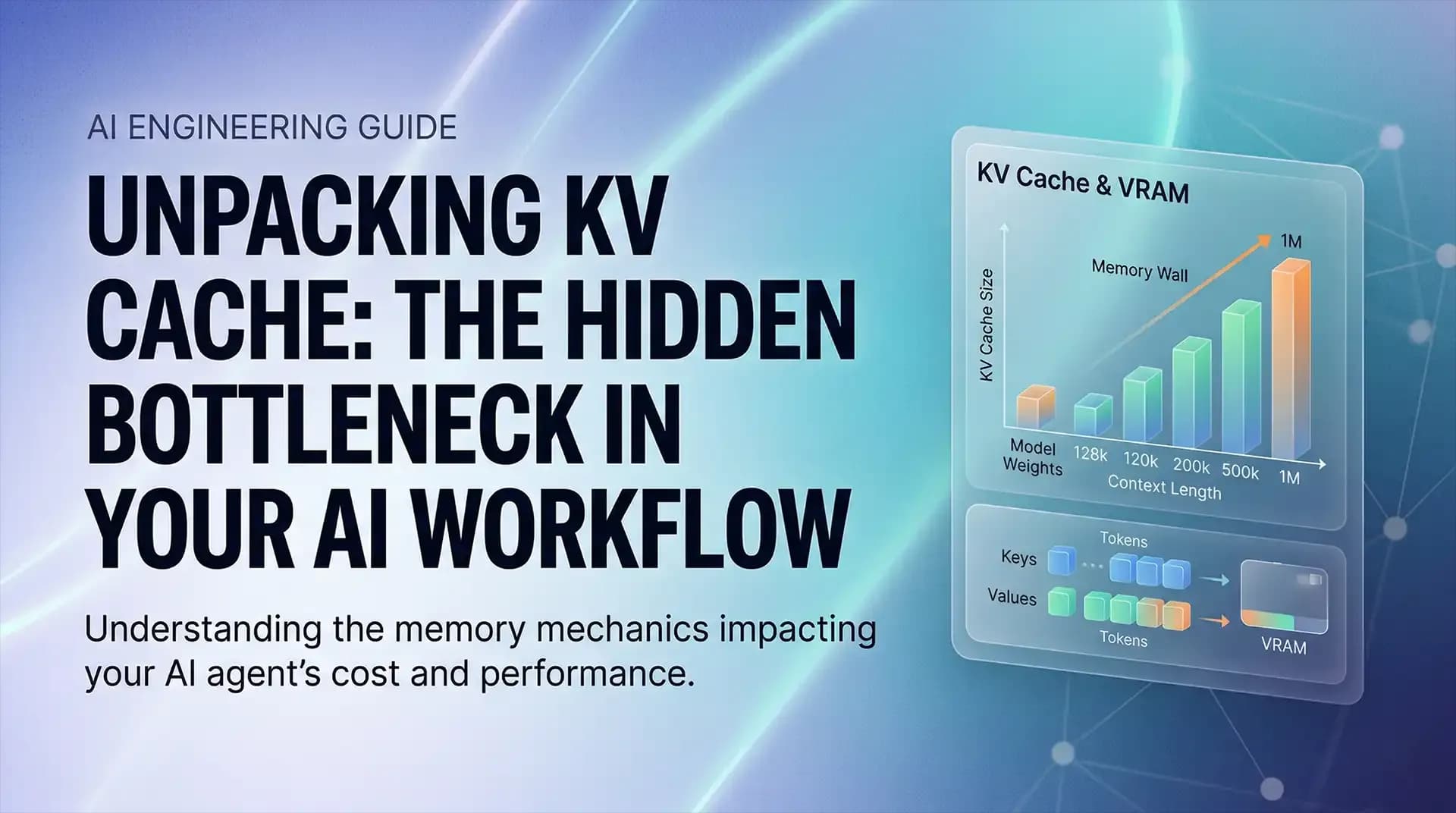
What is KV Cache? The Hidden Bottleneck Behind Your AI Agent’s Cost
Why does an AI agent get slower the more you talk to it? Why does your cloud bill spike when you ask a model to summarize a 500-page PDF? The answer isnt magic'—it’s thewhat is KV cacheproblem.
In 2026, understanding the KV cache is the New Literacy for anyone building in the AI space.
KV Cache Decoded: The Working Memory of Modern LLMs
Think of a Large Language Model (LLM) as a master chef. The model weights are the chefs lifelong knowledge of recipes. But when the chef starts cookingyourspecific meal, they need a Post-It Note to remember what ingredients theyve already added.
Thewhat is KV cacheis that Post-It Note. It stores the intermediate states (Keys and Values) of every word (token) in your conversation. Without it, the model would have to re-read the entire conversation from the beginning every time it wanted to generate a single new word. This would make the AI unusable.
The Math of VRAM: Why Context Windows Arent Free
The problem is that these Post-It Notes arent free. They live in the most expensive real estate in the tech world: GPU VRAM.
You can use theKV cache size calculationto see the Memory Wall in action. For a typical frontier model in 2026, the formula is:
2 × num_layers × num_kv_heads × head_dim × precision_bytes × max_seq_len × batch_sizeAs your context length grows, this number balloons. A 1M token context can easily demand 200GB of VRAM. This is theVRAM constraints for LLMsthat forces most developers to clip their AI’s memory, leading to models that forget previous instructions.
From PagedAttention to vLLM: How We Tamed the Memory Beast
Before the 2026 breakthroughs, we fought this withvLLM optimization. The industry standard wasPagedAttention, a clever way of managing VRAM like a computer manages virtual memory. It stopped fragmentation (wasted space) but it didnt actually make the data smaller.
It was a better way to organize the kitchen, but the Post-It Notes were still the same size.
How Modern Quantization Shrinks the Haystack
The real revolution ishow to optimize KV cachethrough extreme quantization. Methods like Googles TurboQuant now allow us to shrink those Post-It Notes from 16 bits down to 3 or 4 bits per value.
By compressing the working memory, we can fit 6x more context into the same space. This is how we move from 128k token limits to 1M+ token contexts on standard enterprise hardware. It’s the difference between an AI that remembers your name and an AI that remembers your entire company’s codebase.
Throughput vs. Latency: Choosing Your Strategy
When managingLLM inference memory usage, you have to make a choice:
- Throughput: Serve more users at once by compressing the cache.
- Latency: Generate tokens faster by keeping the cache in high-speed memory.
- Accuracy: Using lossless methods like PolarQuant to ensure the AI doesnt get clumsy as it gets efficient.
Conclusion: Knowledge is Power (and VRAM)
In theZero To AIphilosophy, the Human Premium comes from understanding the tools, not just using them. By mastering the KV cache, you arent just a coder; youre anAI Orchestratorwho knows how to scale intelligence without breaking the bank.
FAQ (People Also Ask)
- Q1: Does disabling KV cache make inference faster?
No, it triggers quadratic re-computation, making inference significantly slower.
- Q2: Does KV cache affect model accuracy?
No, it simply stores previous computations. However,quantizingthe cache (like in TurboQuant) requires careful algorithms to maintain accuracy.
Learn to build AI workflows that handle your busywork — live sessions, real projects, zero code.
See the courseBeginner-friendly