.jpg&w=1080&q=75)

What Is RAG? How to Give Your AI Agent a Perfect Memory (No Code)

.webp&w=3840&q=75)
Most AI agents forget everything the moment a conversation ends. Ask your chatbot what you discussed last Tuesday — blank stare. Drop a 200-page company handbook into an AI tool and ask it a specific policy question — hallucinated answer.
RAG — retrieval augmented generation — is the solution. It is the reason enterprise AI systems can answer questions about proprietary documents with accuracy. And with no-code tools available in 2026, it is something any solopreneur can set up in an afternoon.
The Librarian Analogy: Why AI Needs RAG
Think of two assistants. The first has memorized everything they have ever read — but their reading stopped two years ago. They are confident, fast, and sometimes wrong in ways that are hard to detect.
The second has access to a well-organized library. When you ask a question, they walk to the right shelf, pull the relevant pages, read them, and answer you. Their answer is grounded in the actual source material. That second assistant is what RAG gives you.
RAG works by splitting the problem in two. First, a retrieval system finds the most relevant chunks of text from your knowledge base. Then the language model reads those retrieved chunks and generates a response based on that specific content — not guessing from its training data.
What RAG Actually Does
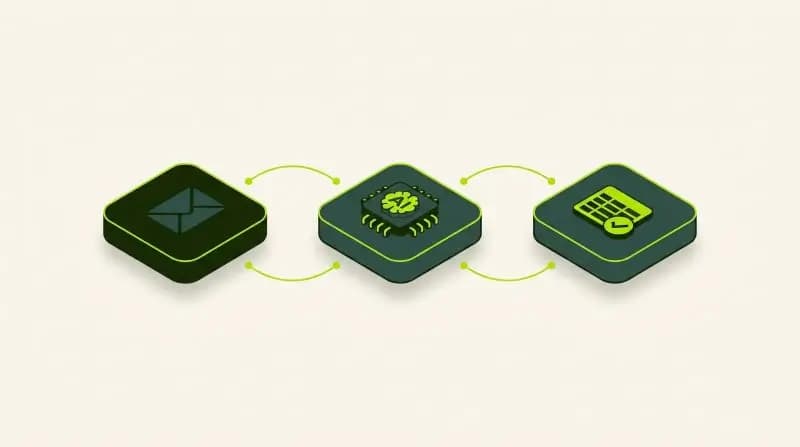
When someone asks your AI agent a question, the question gets converted into a mathematical representation called an embedding that captures its meaning. The system searches your knowledge base for chunks of text with similar mathematical meaning. The most relevant chunks get retrieved and handed to the AI model. The AI reads those chunks and generates a response grounded in that specific content.
Your knowledge base can be updated any time. Add a new document, update a policy — the AI agents answers update accordingly. No retraining the model.
Why Your AI Agent Needs This Right Now
Without RAG, AI agents have three critical failure modes.
Hallucination: the model will confidently answer questions about your business based on statistical pattern-matching — not from your actual documents.
Stale knowledge: even a well-trained AI model has a knowledge cutoff. Anything that changed after that date does not exist for the model.
Context limits: you cannot paste your entire company knowledge base into every conversation. RAG retrieves only what is relevant for each specific question.
How to Build a No-Code RAG Workflow with n8n
You will need an n8n account (cloud or self-hosted), Pinecone free tier for your vector database, an OpenAI or Anthropic API key, and your source documents.
Step 1: Set up your vector database. Create a free account at Pinecone. Create a new Index — choose 1536 dimensions for OpenAIs embedding model.
Step 2: Build your document ingestion workflow in n8n. Connect a trigger, add an Extract from File node, a Text Splitter node to break documents into roughly 500-word chunks, an Embeddings OpenAI node, and a Pinecone node to write those vectors into your index.
Step 3: Build your query workflow. Take the incoming question, convert it to an embedding, search Pinecone for the top 5 most similar chunks, and feed those chunks plus the original question to Claude or GPT with instructions to answer only from the provided context.
Step 4: Connect your agent to a channel. Wire this to a chat widget, Slack bot, WhatsApp Business number, or web form.
Real Use Cases
Customer service bot: Load your product catalog, shipping policies, and FAQs. Your AI agent answers questions with accurate, current answers.
Personal research assistant: Dump every article and note you have collected on a topic and ask your assistant to synthesize across sources.
Internal operations assistant: Upload your SOPs, onboarding docs, and brand guidelines. New team members get accurate answers from your actual documentation.
FAQ
Do I need to know how to code to build a RAG system? No. Tools like n8n, Flowise, and Dify are built specifically for no-code RAG workflows.
How is RAG different from just pasting a document into ChatGPT? Pasting works for a single conversation but does not scale and does not persist. RAG creates a permanent, searchable knowledge base queryable across unlimited documents.
What is the best free vector database for beginners? Pinecones free tier with one index and up to 100,000 vectors is the easiest to get started with.
Build the AI Agent That Actually Knows Your Business
What is RAG AI no code? It is the difference between an AI that sounds helpful and an AI that actually is. The no-code tools to build this exist right now. Start with one use case, load your documents, build the workflow, test it with real questions. Once you see the difference, you will not go back.
Learn to build AI workflows that handle your busywork — live sessions, real projects, zero code.
See the courseBeginner-friendly