.jpg&w=1080&q=75)

Why Vector Databases are the New Memory for AI Agents

Why Vector Databases are the New Memory for AI Agents
Imagine you have a highly intelligent assistant who graduates from Harvard every morning but suffers from total amnesia by the afternoon. Every time you ask a question, you have to re-explain your life story, your business goals, and your past preferences.
That is an AI model without aVector Database.
In 2026, the difference between a Chatbot and an Autonomous Agent isMemory. And in the world of AI, memory is built onVectors.
The Problem: The Goldenfish Context Window
Large Language Models (LLMs) like GPT-4 or Llama 3 have a Context Window. This is their working memory'—the amount of text they can think about at a single moment. While these windows are getting larger, they are still limited and expensive.
If you want an agent to know the contents of a 500-page technical manual, you cant just paste the whole manual into every prompt. You need a way to remind the AI of only the relevant parts.
The Solution: RAG (Retrieval-Augmented Generation)
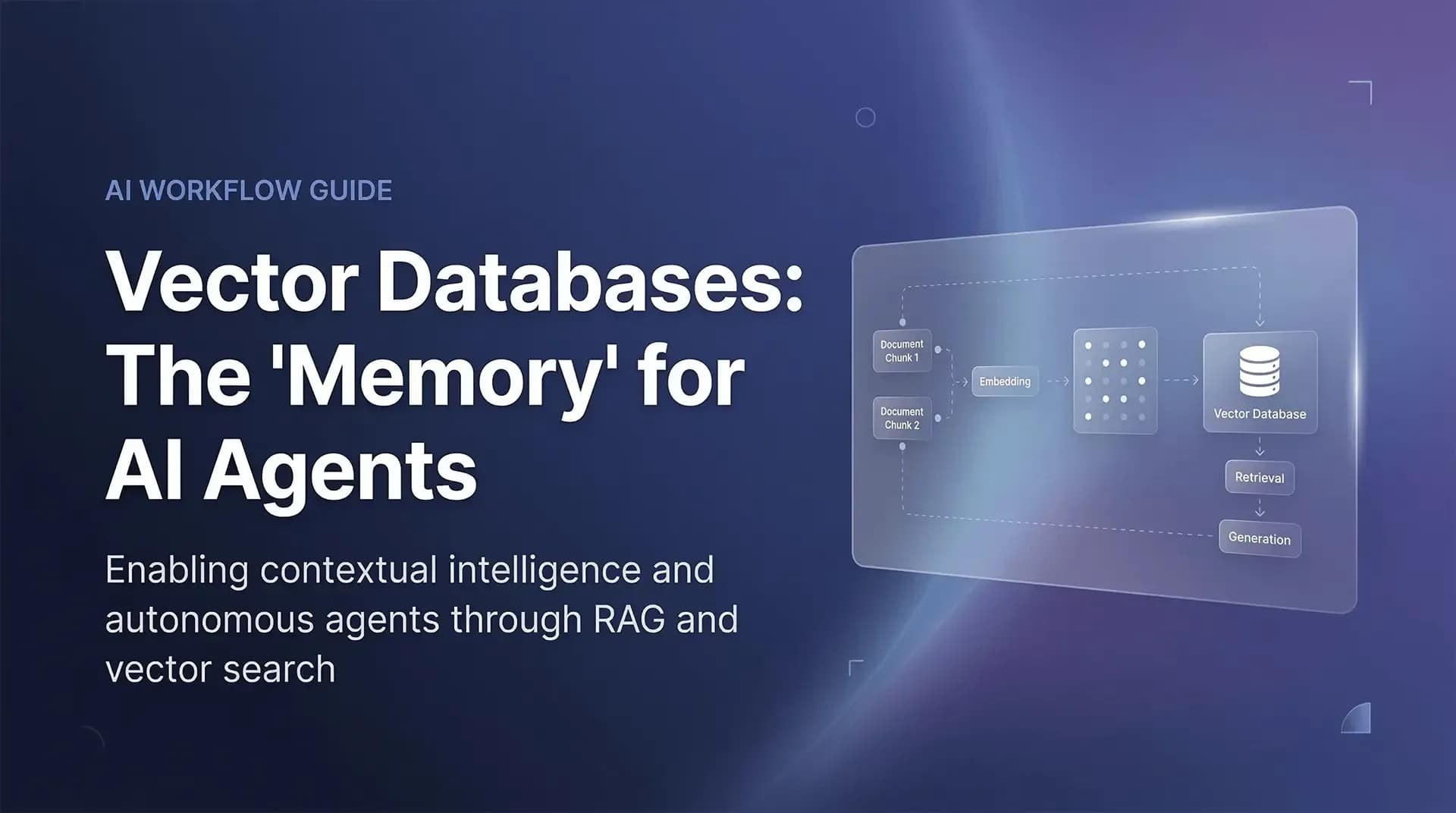
This is wherevector databases for AI agentscome in. They enable a process calledRAG. Here is how it works in 2026:
- Embedding: You take your manual, break it into tiny chunks, and turn those chunks into numbers (called Vectors).
- Storage: You store these numbers in a Vector Database (like Pinecone, Milvus, or Chroma).
- Retrieval: When you ask the agent a question, the agent looks at the database for themathematically closestchunks of information.
- Generation: The agent remembers those specific chunks and uses them to answer your question.
Res'ults: Your agent now has infinite knowledge without the massive cost of a huge context window.
Why Vectors and not just Keywords?
Traditional databases search for words. If you search for automobile, a traditional database might miss a paragraph about cars.
AVector Databasesearches formeaning. It understands that automobile and car are practically the same thing in a multi-dimensional mathematical space. This allows yourAI Agentto be intuitive. It can find answers even if you dont use the exact terminology found in the source documents.
Top Vector Databases for Agents in 2026
If youre building an agent today, these are the leaders:
- Pinecone: The gold standard for managed, cloud-based vector search. Perfect for scaling fast.
- Milvus / Zilliz: For enterprise-grade, massive-scale memory systems.
- Chroma: Open-source and incredibly easy to set up for local-firstPersonal AI Operating Systems.
- Supabase (pgvector): If you already love SQL, this brings vector power to your existing Postgres database.
Conclusion: Memory Equals Utility
An AI that doesnt remember is just a toy. An AI that remembers your past decisions, your companys documentation, and your personal preferences is aBusiness Asset.
As we move into the Post-Execution Economy, the value of an AI agent will be determined by its Contextual Intelligence. And that intelligence is powered by the silent, mathematical work of the Vector Database.
FAQ
Q: Do I need a vector database for a simple chatbot?
Probably not. If you only need to answer questions about a single document, a large context window might suffice. But for any long-running agent project, it’s essential.
Q: Are vector databases expensive?
In 2026, there are many Serverless options that allow you to start for free and only pay for what you store and search.
Q: Can I use a vector database for images?
Yes! Vectors can represent text, images, audio, and even video—allowing your agents to remember anything theyve seen or heard.
Learn to build AI workflows that handle your busywork — live sessions, real projects, zero code.
See the courseBeginner-friendly