.jpg&w=1080&q=75)

Agent Evals 101: How to Actually Test if Your AI Workflow is Reliable

We have all been there. You spend an afternoon visually connecting nodes in n8n. You click Execute. The agent perfectly processes your test data. You celebrate, deploy it... and three days later, it hallucinates wildly, sends a corrupted email to a client, and crashes.
Building a demo is easy. Building a reliable agent is hard. The difference between an amateur builder and a professional orchestrator lies entirely in one concept: Agent Evals. If you want to build AI that actually works, you have to know how to test it.
The Demo Illusion
When you search for tutorials on building AI agents, you’ll find hundreds of videos showing perfect happy path scenarios. The creator types a prompt, and a magical outcome occurs.
But real-world data is messy. APIs fail, users provide weird inputs, and LLMs are inherently probabilistic. If you deploy an agent without testing edge cases, you arent building production grade AI agents; you are building liabilities. The shift from tinkerer to developer happens the moment you admit your AI will fail.
What Are Agent Evals?
Evals (Evaluations) are a systematic framework for measuring the performance, accuracy, and safety of your AI agent across hundreds of simulated scenarios.
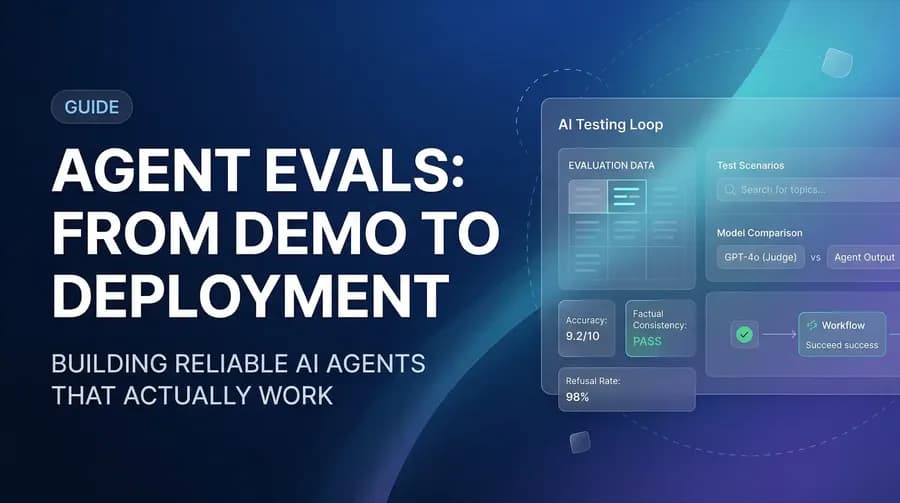
Think of this agent evals beginner guide as a reality check for your bot. Instead of testing it with one prompt, you feed it 100 historical examples and grade its outputs automatically. You test for factual consistency, formatting accuracy (did it output JSON as requested?), and boundary adherence (did it refuse to answer off-topic questions?).
Setting Up a Testing Loop
You dont need a PhD in machine learning to test your workflows. If you want to know how to test AI agents with no code, use another LLM as the judge.
In your orchestration tool, build a secondary Test Loop. This loop pulls 50 random inputs from a spreadsheet, runs them through your primary agent, and captures the outputs. Then, it sends those outputs to a highly logic-driven LLM (like GPT-4o) with a grading rubric. The grading LLM scores the output on a scale of 1 to 10 for accuracy and tone.
If the average score is below 9.0, you know your prompt needs adjusting before you hit Publish.
Conclusion: Reliability as a Feature
The world is waking up to the unreliability of basic chatbots. When you focus on structured Evals, you elevate your skill set above 99% of AI experts on the internet.
Want to master production-grade pipelines?Join the Zero to AI 90-Day Reskilling Workshopand start engineering robust, unbreakable agent workflows.
Learn to build AI workflows that handle your busywork — live sessions, real projects, zero code.
See the courseBeginner-friendly