.jpg&w=1080&q=75)

Multi-Agent Teams: The Microservices moment for AI

Multi-Agent Teams: The Microservices moment for AI
If you’re still trying to get one single AI model to handle your entire business process, you’re essentially asking a world-class violinist to also play the drums, manage the lighting, and sell tickets at the door. Itmightwork, but it won’t be a masterpiece.
Early in the AI revolution, we were amazed by the Generalist. But by March 2026, the industry has shifted toward theSpecialist. We have reached the Microservices Moment for Artificial Intelligence.
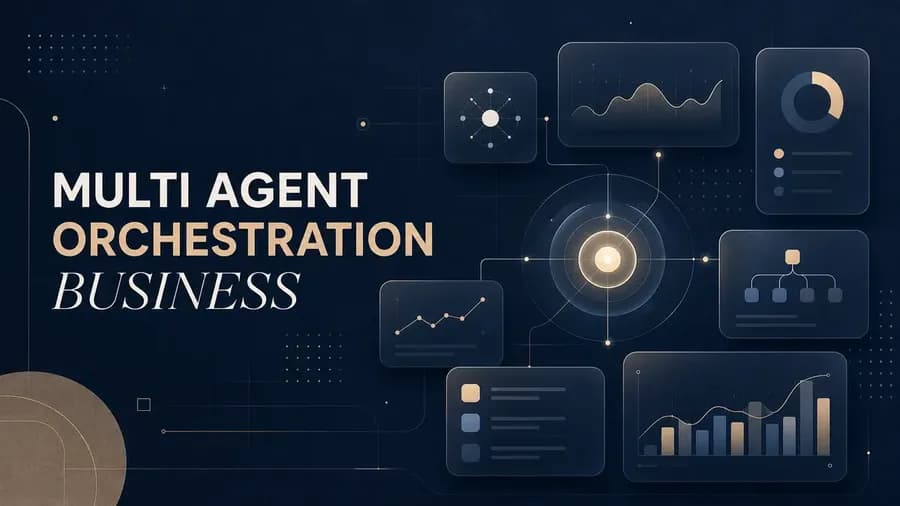
Instead of one giant prompt, we are now buildingmulti-agent orchestrationsystems—teams of distinct, autonomous agents that each handle a single part of a complex goal. Here is why The Team always beats The Prompt.
Why Single Models Hallucinate (And How Teams Fix It)
The biggest weakness of a single Large Language Model (LLM) is its desire to be helpful. When you give a single model a 10-step complex task, its attention is spread thin. It starts to take shortcuts, skips steps, or—worst of all—hallucinates data to fill the gaps in its logic.
Multi-agent teams solve this throughSeparation of Concerns. In a properly orchestrated team:
- Agent A (The Researcher)focuses only on gathering facts.
- Agent B (The Writer)focuses only on the tone and structure.
- Agent C (The Critic)focuses only on finding errors.
By breaking the problem down, you ensure that no single model is overwhelmed. This is the shift from asking a machine to think to designing a machine to work.
LangGraph vs. AutoGen: Choosing your Orchestration Runtime
In 2026, you dont just talk to AI; you choose a runtime to manage it. There are two dominant philosophies inmulti-agent orchestration:
- Structured Logic (LangGraph): Think of this as a flowchart. You define the exact path the data takes between agents. It is predictable, secure, and perfect for production environments like legal or finance where emergent behavior is a risk.
- Dynamic Dialogue (AutoGen/CrewAI): Think of this as a group chat. You give agents roles and let them talk to each other to figure out the best result. It is highly creative and excels at problem-solving, but requires more oversight to ensure the conversation stays on track.
AtZero To AI, we teach a hybrid approach:Stateful Workflows. Use structure for the process, but allow agents the freedom to iterate within their specific nodes.
The Verifier Loop: The Secret to 99% Accuracy
The most powerful part of an agentic team is theVerifier Loop. In a single-prompt environment, the AI is its own judge. In a multi-agent environment, you can implement Self-Correction as a feature.
Imagine an agent tasked with generating financial reports. In an orchestrated workflow, the Producer Agent creates the report, but it cannot publish it. The data must first pass through a Validator Agent that re-runs the calculations. If the numbers dont match, the Validator sends a critique back to the Producer for a rewrite.
This Red-Green loop continues until the audit passes. This isnt just automation; it’sAgentic Quality Assurance.
Scaling Your Team: From Two Agents to Two Hundred
The beauty of the microservices model is scalability. Once you have a Research Node that works for one department, you can instantiate it for every department in your company.
You arent hiring more people; you are clicking Duplicate on your successful agentic patterns. By late 2026, the leanest, most profitable companies on earth are those with a human headcount of five and anagentic workforceof 500.
Conclusion: Dont Prompt. Orchestrate.
The era of the Generalist Chatbot was just the prologue. The real story of AI in 2026 is the story of theOrchestrator—the person who knows how to assemble a digital Dream Team.
When you move from prompting to orchestration, you stop struggling with AI output quality and start managing AI output systems.
Ready to build your first Dream Team?
[Explore the Zero To AI Agentic Framework] and learn how to coordinate multiple agents for complex, real-world business outcomes.
FAQ (People Also Ask)
Q: Is it expensive to run multiple agents at once?It depends on the model. In 2026, we typically use Frontier models (like GPT-5.4) for the Orchestrator and Small models (like Llama 3.2) for the specialized nodes to keep costs low.
Q: Do agents in a team share the same memory?Only if you design it that way. InLangGraph, we use State Management to pass a specific shared memory object between agents so everyone stays on the same page.
Q: What is the best framework for beginners?CrewAIis excellent for conceptualizing Roles and Tasks, whilen8nis the best visual way to see your orchestration in action without writing code.
Learn to build AI workflows that handle your busywork — live sessions, real projects, zero code.
See the courseBeginner-friendly