.jpg&w=1080&q=75)

Mastering the n8n Agentic Loop: A 2026 Guide for Non-Coders

Mastering the n8n Agentic Loop: A 2026 Guide for Non-Coders
In 2026, linear automation is dead. If your workflow still looks like a straight line—if this happens, then do that—you’re leaving massive value on the table. Discover how to move from "If-This-Then-That" to the n8n agentic loop, a circular logic powered by the Sense-Plan-Act cycle that turns simple automations into autonomous assistants. No coding required.
At zerotoai, we’ve seen thousands of professionals struggle with the "Execution Tax"—the time spent managing brittle automations that break the moment a variable changes. The solution isn’t more code; it’s better orchestration.
Why Linear Automation Fails in the Age of GPT-5.4
For years, tools like Zapier defined how we worked: Step A leads to Step B. But in 2026, when you’re n8n vs Zapier for AI, the winner is clear. Traditional linear automation is fragile. If an AI summarizer returns a slightly different format than expected, a linear workflow often crashes.
The n8n agentic loop is different. Instead of a straight line, it’s a circle. If the AI "senses" an error or an unexpected input, it can "plan" a new route and "act" again. This is the shift from being a "Digital Worker" to becoming an "AI Orchestrator." You aren't just building a path; you're building a brain.
Key Insight: Linear automation follows rules; Agentic loops follow goals.
The Anatomy of an Agentic Loop: Sense, Plan, Act
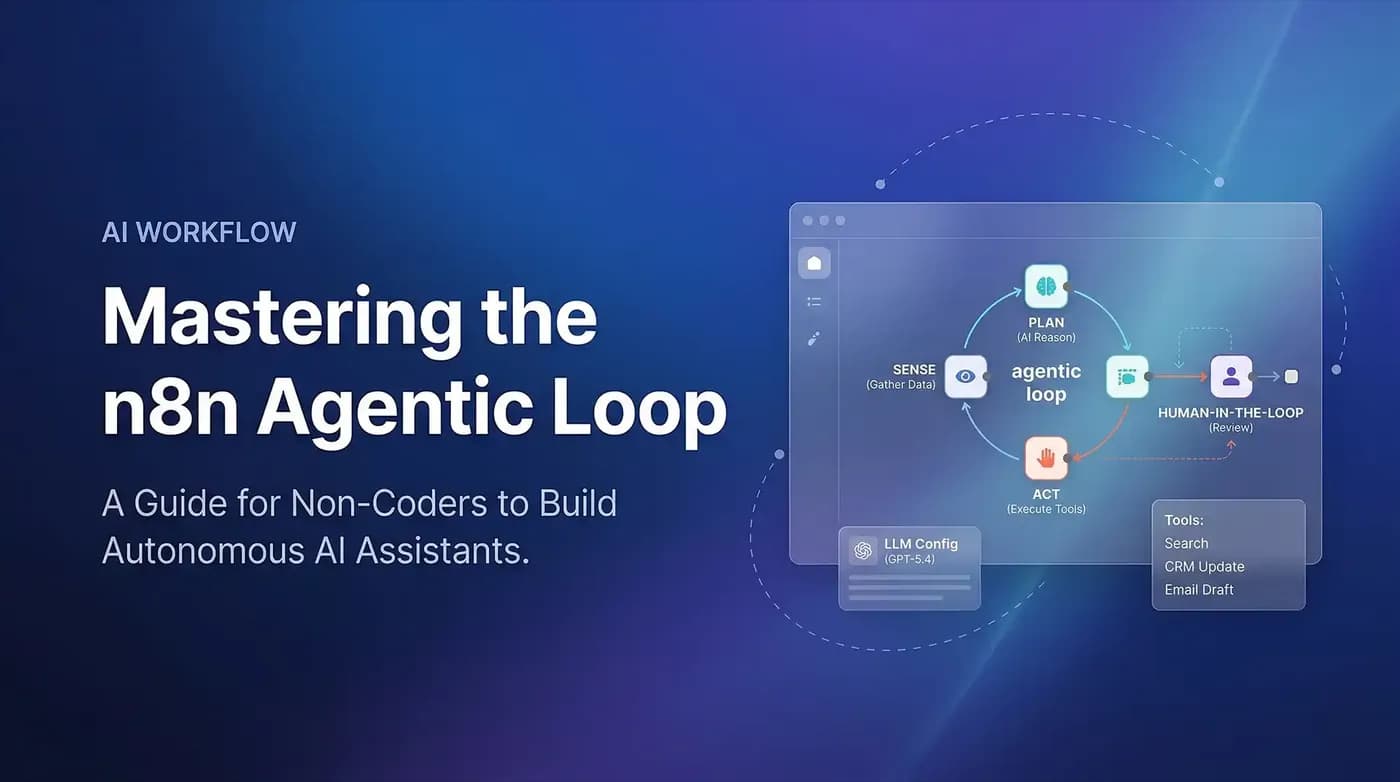
To master building ai agents n8n, you must first understand the "Sense-Plan-Act" cycle. This is the core logic inside the n8n Agent Node.
1. Sense: The agent gathers information. This could be an incoming email, a database entry, or data fetched from a Vector Store.
2. Plan: The LLM (the "Brain") looks at the data and the tools available. It asks: "What is the best next step to achieve the goal?"
3. Act: The agent executes a "Tool"—which in n8n is often just another sub-workflow you’ve already built.
This circularity allows the agent to retry, refine, and reason until the task is complete.
Setting Up Your First "Brain": Connecting LLMs to n8n
The first step in any n8n agent node tutorial is choosing your "Brain." In 2026, you have options: Google Gemini 1.5 Pro for massive context windows, OpenAI GPT-5.4 for complex reasoning, or Anthropic Claude 4 for nuanced writing.
In n8n, you simply drag the "AI Agent" node onto the canvas and connect it to an "LLM Chain" node. This gives your agent the ability to process natural language and make decisions based on the "Instructions" (System Prompt) you provide.
Turning Workflows into "Skills" with the Tool Node
The true power of autonomous workflows n8n comes from "Tools." A tool is a specific "skill" you give your agent.
Want your agent to search the web? Create a sub-workflow that uses the HTTP Request node and link it as a "Tool." Want it to update your CRM? Build that workflow once, and the Agent Node can "call" it whenever it decides it's necessary.
By wrapping your existing automations as tools, you transform your n8n canvas into a library of capabilities that the AI can deploy at will.
The "Human-in-the-Loop" (HITL): Why Your Agent Needs a Manager
Total autonomy is a myth—and a risk. This is where human-in-the-loop (HITL) orchestration becomes your greatest competitive advantage.
In n8n, you can use the "Wait for Webhook" node to pause an agentic loop. For example, your agent can research a lead and draft an email, but it waits for your click to actually hit "Send." This isn't a bottleneck; it's "Ethical Orchestration." It ensures the "Human Premium"—your judgment and taste—is always the final gate.
From User to Orchestrator: Your 30-Day Roadmap
If you’re looking for n8n for beginners 2026, don't start by trying to build a digital twin. Start small.
• Week 1: Automate a single research task using the Agent Node.
• Week 2: Create your first "Tool" from a sub-workflow.
• Week 3: Implement a HITL approval step.
• Week 4: Connect a Vector Store to give your agent "Long-Term Memory."
At zerotoai, our mission is to make this transition feel easy. You don't need to be a developer to build the future; you just need to be an Orchestrator.
Conclusion: Stop Building Paths, Start Building Brains
The "Agentic Loop" is more than a technical feature; it’s a mindset shift. By moving away from brittle, linear paths and toward resilient, circular reasoning, you unlock the full potential of GPT-5.4.
Don't compete with the AI; learn to direct it.
Ready to build your first autonomous assistant? [Join our n8n Agent Workshop] and go from "Zero to AI Orchestrator" in just 2 hours.
FAQ (People Also Ask)
Q: Do I need to know Python to use n8n agents?
A: No. While n8n supports code, its primary strength in 2026 is "No-Code Orchestration." You can build complex agentic loops using the visual canvas and natural language instructions.
Q: Is n8n better than Zapier for AI agents?
A: Yes. Zapier is excellent for linear "If-This-Then-That" tasks. However, n8n’s native "Agent Node" and "Tool" architecture are specifically designed for the circular reasoning required by modern AI.
Q: How do I prevent my AI agent from "going rogue"?
A: Use the "Supervisor" pattern and "Human-in-the-Loop" (HITL) nodes. Always ensure high-stakes actions (like spending money or sending public messages) require a manual approval step.
Internal Links & Resources
• [Will GPT-5.4 Take Your Job? 5 Skills that AI Agents Still Can't Automate (Yet)](../blog-ai-job-reskilling-2026.md)
• [Quit GPT: Why 2026 is the Year of the Local AI Agent](../blog-quit-gpt-local-agents-2026.md)
Learn to build AI workflows that handle your busywork — live sessions, real projects, zero code.
See the courseBeginner-friendly