.jpg&w=1080&q=75)

OpenClaw vs. GPT-5.4: Which AI Agent Should Control Your Computer?

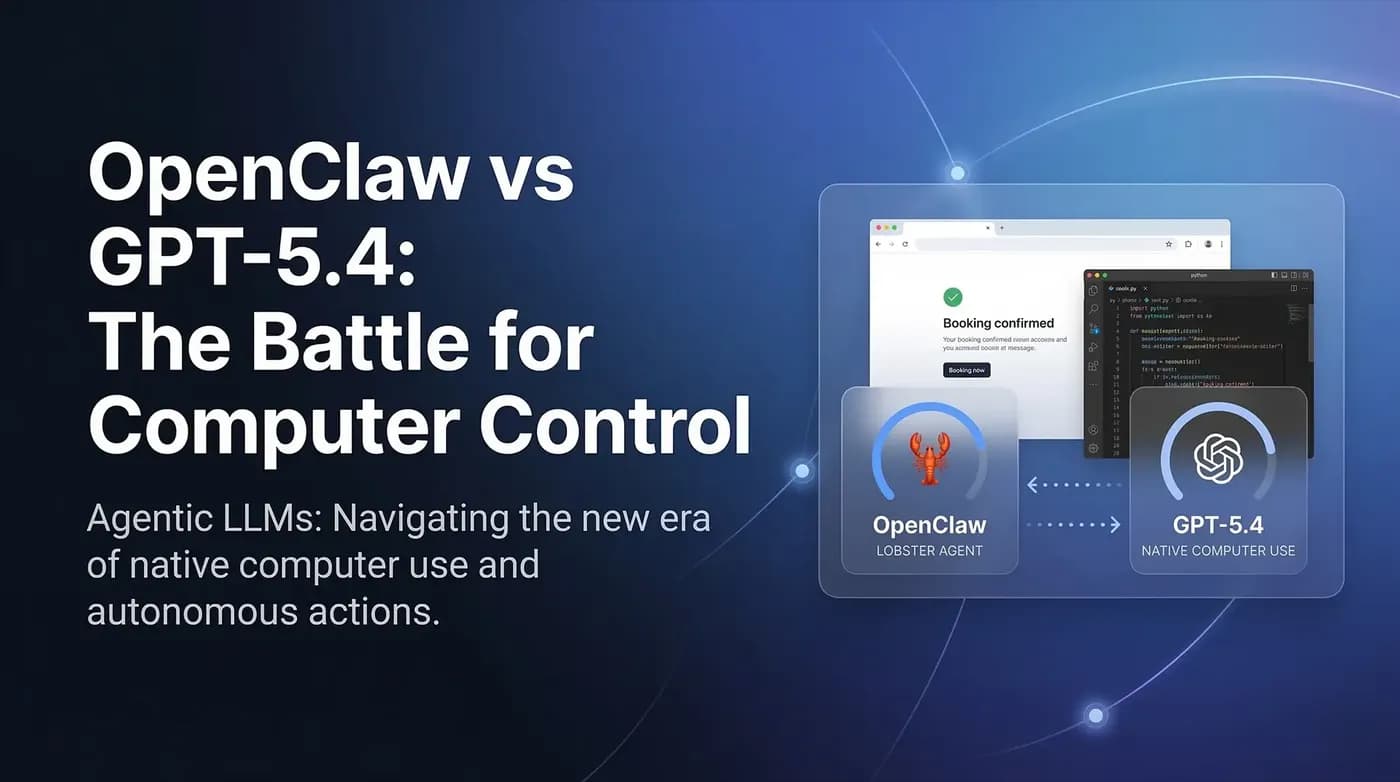
OpenClaw vs. GPT-5.4: Which AI Agent Should Control Your Computer?
For decades, we’ve used computers by clicking, typing, and scrolling. In March 2026, that era is ending. We are moving from Software as a Service (SaaS) toAgent as a Service(AaaS).
The two biggest names dominating this shift areOpenClawandGPT-5.4. These arent just smarter chatbots; they are Agentic LLMs capable of native computer use. They can open your browser, book a flight, scrape a website, and even debug a Python script—all by interacting with the user interface just like a human would.
But with great power comes a massive debate: Should you trust an open-source digital lobster or the latest proprietary powerhouse from OpenAI?
Atzerotoai, we’ve tested both to see which one makes AI feel easy and which one actually delivers on the promise of autonomous computing. Here is the definitive breakdown ofOpenClaw vs GPT-5.4.
The Agentic Revolution: Why We Stopped Chatting and Started Doing
The Chatbot Era (2022-2025) was about generating text. The Agentic Era (2026+) is about generatingActions.
In the past, if you wanted an AI to book a restaurant, it needed an API connection to OpenTable. If OpenTable didnt have an API, the AI was stuck. Today, GPT-5.4 and OpenClaw dont need APIs. They have Vision-to-Action capabilities. They see the website on your screen, find the Book Now button, and click it.
This shift is whyOpenClaw vs GPT-5.4is the most searched comparison of the year. It’s no longer about who writes the best poem; it’s about who is the best Digital Assistant.
OpenClaw: The Open-Source Lobster Taking Over GitHub
If you spend any time on GitHub, you’ve seen the lobster emoji 🦞. It’s the symbol ofOpenClaw, the community-driven agentic model that has amassed over 250,000 stars in record time.
What makes OpenClaw unique?
- Complete Transparency: Unlike OpenAI, every line of OpenClaw’s code is open. You know exactly how it’s making decisions.
- Privacy-First: You can run OpenClaw locally on your own hardware (using a high-end GPU or a cloud instance you control). Your data never touches a corporate server.
- The Lobster Meme: It’s a cultural phenomenon. Users are raising their lobsters—fine-tuning them for specific tasks like high-frequency trading or extreme research.
The Downside: OpenClaw requires a bit more tinkering. It’s not a one-click setup like its competitor.
GPT-5.4: OpenAI’s Native Computer-Use Powerhouse
Released in early March 2026,GPT-5.4is the polished, professional heavyweight. It features OpenAIs Native Computer Use (NCU) architecture, which is built directly into the models core.
Why GPT-5.4 is Winning the Corporate World:
- Native Computer Use (NCU): OpenAI’s vision model is incredibly fast at recognizing UI elements. It rarely misclicks, even on complex, non-standard websites.
- 1-Million-Token Context Window: It can remember a massive amount of documentation and previous actions, making it perfect for long, multi-step workflows.
- The Ecosystem: It integrates perfectly with ChatGPT Plus, giving you a smooth mobile-to-desktop experience.
The Downside: It’s a black box. You dont know how it works, and you have to trust OpenAI with your screen data.
Security & Privacy: The Risk of Giving AI Inject_Events Permissions
This is where the debate gets heated. Both models requireInject_Eventspermissions to control your mouse and keyboard.
If a malicious AI has these permissions, it could theoretically open your banking app and transfer funds while you arent looking.
- GPT-5.4handles this with corporate safeguards. It has a Safety Layer that blocks certain actions (like entering credit card info) unless a human gives a Biometric Okay.
- OpenClawhandles this with transparency. Because it’s open-source, the community audits the security. If you run it locally, you can physically pull the internet plug if you get nervous.
Atzerotoai, we recommend theHuman-in-the-Loopapproach for both. Never let an agent operate 100% autonomously without an Approval Gate for high-stakes actions.
Performance Benchmarks: Speed, Reasoning, and Reliability
In our labs, we ran both models through a Digital Assistant Pentathlon:
- Web Scraping & Synthesis: OpenClaw won on speed. It’s leaner and faster at navigating simple text-heavy sites.
- Complex Software Interaction (Photoshop): GPT-5.4 won on precision. Its NCU model understood the nested menus of Photoshop better than OpenClaw.
- Creative Problem Solving: GPT-5.4 showed slightly better reasoning when a website layout changed unexpectedly.
- Local Latency: OpenClaw (running on a local RTX 5090) beat GPT-5.4’s cloud-based response time by 300ms.
Verdict: When to Choose OpenClaw and When to Stick with OpenAI
There is no single winner in theOpenClaw vs GPT-5.4war. It depends on your values:
Choose OpenClaw if:
- You value privacy above all else.
- You like to tinker and customize your AI’s personality.
- You want to avoid monthly subscription fees by running local hardware.
Choose GPT-5.4 if:
- You want it to just work out of the box.
- You are a business owner who needs enterprise-grade support.
- You need the highest level of visual precision for complex software tasks.
Conclusion: The Future of Autonomous Computing is Here
Whether you choose the open-source lobster or the OpenAI powerhouse, the message is clear: the way we use computers has changed forever. The Fear of AI is being replaced by the Utility of AI.
The goal isnt to be a coder anymore; its to be aDirector.
Atzerotoai, we teach you how to direct these agents. Whether youre building an autonomous lead gen machine or a virtual personal assistant, we make the transition to the Agentic Era fast and easy.
Ready to build your first agent?
[Check out our n8n Agent Builder Guide] and see how to connect OpenClaw or GPT-5.4 to your daily workflows today.
FAQ (People Also Ask)
Q1: Is OpenClaw free?The code is free (open-source), but you still have to pay for the Compute (either your own electricity/hardware or a cloud provider like Groq or Lambda).
Q2: Does GPT-5.4 see my screen all the time?Only when you activate the Computer Use mode. OpenAI has stated they do not store persistent screen recordings, but they do use anonymized action traces to train future versions.
Q3: Can these agents actually steal my password?Technically, an agent with Inject_Events permissions could see what you type. This is why you should only use trusted, audited models and always keep a Human-in-the-Loop for sensitive data.
Q4: Which one is better for beginners?GPT-5.4 is significantly easier for beginners because of its polished interface and 24/7 support. OpenClaw is better for the AI-Curious who want to learn how the engine works.
Learn to build AI workflows that handle your busywork — live sessions, real projects, zero code.
See the courseBeginner-friendly