.jpg&w=1080&q=75)
Prompt Engineering for Non-Coders: 7 Practical Templates for Daily Business Tasks

Prompt Engineering for Non-Coders: 7 Practical Templates for Daily Business Tasks
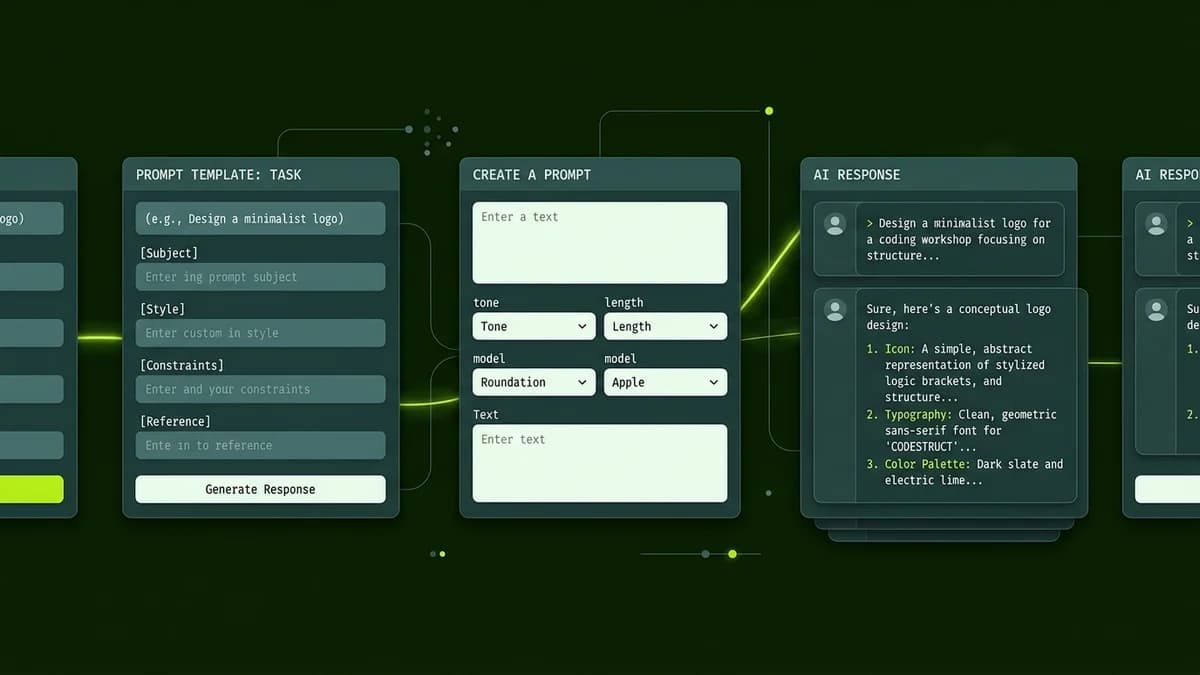
Non-technical professionals can get highly accurate, professional results from AI tools like ChatGPT and Claude by following a simple four-part prompt framework consisting of Role, Context, Task, and Constraint instructions.
Most small business owners who try AI tools report getting vague or overly generic responses. This happens not because the AI models are incapable, but because standard text prompts lack the specific business context, tone guidelines, and output formatting rules necessary for professional work.
You do not need a computer science degree or programming knowledge to write world-class prompts. By mastering a few core prompting principles, non-coders can transform AI chatbots into reliable, full-time business assistants.
The 4-Part Non-Coder Prompting Framework
┌─────────────────────────────────────────────────────────────┐
│             THE R-C-T-C NON-CODER PROMPT FRAMEWORK          │
│                                                             │
│  1. ROLE       ──> "Act as a Senior Business Strategist..." │
│  2. CONTEXT    ──> "We are a 5-person digital agency in..." │
│  3. TASK       ──> "Write a polite email negotiating..."   │
│  4. CONSTRAINT ──> "Keep under 150 words, use bullet..."    │
└─────────────────────────────────────────────────────────────┘
The R-C-T-C Framework ensures the AI understands exactly what you want every single time:
Framework Element | Purpose | Non-Coder Example |
|---|---|---|
Role | Sets the AI's perspective and expertise level | "Act as an expert B2B copywriter for small businesses." |
Context | Provides background details and audience info | "Our client is a non-technical founder looking for easy workflow tools." |
Task | Specifies the exact action required | "Write a 3-paragraph email summarizing the project proposal." |
Constraint | Sets boundaries on length, tone, and format | "Do not use technical jargon. Use bullet points and under 200 words." |
7 Plug-and-Play Business Prompt Templates
Copy and adapt these seven proven prompt templates for your daily work:
1. The Executive Summary Prompt
"Act as an executive assistant. Read the attached 10-page market report. Summarize the top 5 key takeaways in a bulleted list. Highlight any specific risks for small business owners in non-technical terms."
2. The Customer Email Tone Polisher
"Act as a corporate communications specialist. Rewrite this draft customer response email to sound warm, empathetic, and professional while maintaining our firm policy on refund timelines. Draft: [Insert Draft]"
3. The Competitor Analysis Generator
"Act as a market researcher. Compare Product A and Product B based on pricing, ease of use for non-coders, and customer support. Format the output as a Markdown comparison table."
4. The Social Media Repurposing Engine
"Act as a social media strategist. Take this 500-word blog summary and convert it into 3 distinct LinkedIn text posts. Use engaging opening hooks, short sentences, and relevant business hashtags. Summary: [Insert Text]"
5. The Meeting Action Item Extractor
"Act as a project manager. Read the following meeting transcript. List all agreed action items, the assigned team member for each task, and the requested completion deadline. Transcript: [Insert Notes]"
6. The Standard Operating Procedure (SOP) Creator
"Act as an operations consultant. Turn these raw step-by-step notes into a clean, numbered Standard Operating Procedure document for training new team members. Raw Notes: [Insert Notes]"
7. The Customer FAQ Builder
"Act as a customer success manager. Based on these 10 customer inquiry emails, generate a 5-question Frequently Asked Questions (FAQ) list with clear, direct answers."
Frequently Asked Questions (PAA)
What is prompt engineering for non-coders?
Prompt engineering for non-coders is the skill of structuring plain-language instructions so that generative AI models like ChatGPT and Claude produce precise, useful business results.
Do I need to learn coding to become good at prompt engineering?
No! Effective prompt engineering for business tasks relies entirely on clear communication, domain knowledge, and logical structuring—not programming code.
Which AI tool is best for business prompting?
Both ChatGPT Team and Claude 3.5 Sonnet excel at business prompting. Claude is exceptionally strong at long document analysis and copywriting, while ChatGPT excels at web research and data tasks.
How long should a good business prompt be?
A good prompt should be as long as necessary to provide complete context and constraints. Detailed prompts (100–300 words) almost always outperform short 5-word queries.
Quick Tips for Daily Business Prompting
- Always specify the output format (e.g., table, bullet points, or email template).
- Ask the AI to ask you clarifying questions if it needs more information before writing.
- Save your best-performing prompt templates in a central digital notepad for quick daily reuse.
Learn to build AI workflows that handle your busywork — live sessions, real projects, zero code.
See the courseBeginner-friendly