.jpg&w=1080&q=75)
The Rise of the AI Orchestrator: Why Just 'Using AI' Isn't Enough Anymore

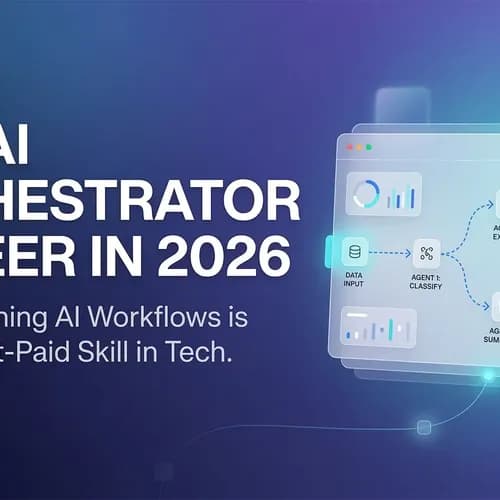
AI Orchestrator Career 2026: Why Just Using AI Isn't Enough
82% of executives expect AI agents working inside their teams within 18 months — but only 23% feel confident they can actually manage them.
That gap? That's your career opportunity.
There's a rapidly widening divide happening in every industry right now. On one side: people who use AI tools. They prompt ChatGPT, generate images, summarize emails. On the other side: people who orchestrate AI — who design the systems, connect the agents, define the logic, and make sure everything doesn't go sideways.
Guess which side employers are paying 56% more for.
The AI orchestrator career is one of the fastest-rising roles of 2026. And the best part? You don't need a computer science degree to get there. You need the right mental model — and the right skills.
What Is an AI Orchestrator, Exactly?
Think of a traditional orchestra. The musicians (AI agents) are incredibly talented. But without a conductor, you get noise, not music.
An AI orchestrator is that conductor.
More specifically, an AI orchestrator designs and manages systems where multiple AI agents, tools, and workflows collaborate to accomplish complex tasks. They decide:
• Which AI model handles which task
• How information flows between agents
• When a human needs to step in (and why)
• How to catch errors before they become disasters
• How to measure whether the system is actually working
This isn't about writing code (though that helps). It's about systems thinking, process design, and knowing AI well enough to trust it — but not blindly.
"The most valuable person in any AI-enabled company isn't the one who uses the most tools. It's the one who knows how to make the tools work together." — Eightfold AI, 2026 Workforce Trends Report
Why "Just Using AI" Has Become a Commodity Skill
Let's be honest. In 2023, knowing how to write a decent prompt felt like a superpower. In 2026, it's table stakes.
Nearly every knowledge worker now has access to AI tools. Most of them use them, at least occasionally. The differentiation has shifted.
Here's what the market is actually rewarding in 2026:
• Tool fluency has dropped in premium value — it's expected
• System design — knowing how to connect tools into workflows — commands a significant premium
• Governance and oversight — ensuring AI behaves responsibly — is becoming its own specialty
• Domain + AI combination — being a finance expert and an AI orchestrator is worth far more than either alone
The workflow automation market is projected to hit $23.77 billion in 2025 and $37.45 billion by 2030. Organizations aren't just buying AI tools. They're desperately searching for people who can deploy those tools at scale, with accountability.
That's the AI orchestrator.
The Five Core Skills of an AI Orchestrator Career in 2026
You don't become an AI orchestrator by downloading one more app. You develop a specific skill cluster. Here's what the role actually demands:
1. Task Decomposition
Can you take a complex business goal — "reduce customer churn by 15%" — and break it into discrete tasks that AI agents can execute? This is analytical thinking applied to AI systems.
2. Agent Design and Selection
There are dozens of AI models and tools for any given task. An orchestrator knows which tool fits which job: when to use a large language model versus a retrieval system versus a specialized classifier.
3. Human-in-the-Loop Design
Not every AI decision should be autonomous. A great orchestrator knows exactly where to insert human checkpoints — for legal compliance, ethical judgment, or simply because the stakes are too high to automate.
4. Quality Control and Evaluation
How do you know if your AI system is working? Orchestrators build evaluation frameworks: testing outputs, catching hallucinations, measuring drift, and iterating.
5. Change Leadership
This is the skill most people overlook. Deploying AI means changing how teams work. Orchestrators need to bring people along — explaining what agents are doing, building trust, and managing resistance.
Organizations with dedicated orchestration specialists achieve full agent productivity 65% faster and report 3x higher employee satisfaction. That's not a small edge. That's a structural advantage.
Who Is Making This Transition Right Now?
The AI orchestrator career path isn't exclusive to engineers. In fact, some of the most successful orchestrators are coming from unexpected backgrounds:
Project managers already know how to coordinate complex workflows and keep humans aligned. Adding AI agent management to that skillset is a natural extension.
Operations specialists understand business processes deeply. Teaching them to map those processes onto AI systems is often faster than teaching an engineer to understand the business.
Domain experts — lawyers, marketers, healthcare professionals — who develop AI fluency become extraordinarily valuable. They know which mistakes are catastrophic and which are acceptable, a judgment call no model can fully replicate.
Developers are evolving too. The developer-to-orchestrator transition is already well underway. Managing AI agents rather than writing every line of code is becoming the norm, not the exception.
What Does an AI Orchestrator Actually Do Day-to-Day?
Here's a realistic picture of the role in practice:
Morning: Review overnight agent runs. Did the customer support AI handle edge cases correctly? Were there any escalations that shouldn't have been escalated?
Mid-morning: Design a new sub-workflow for the content team — an agent pipeline that researches, drafts, and flags articles for human review before publication.
Afternoon: Meeting with legal to establish guardrails for the contract review AI. Document the rules. Build the logic.
Late afternoon: Metrics review. Which agents are underperforming? What's the cost per task? Is the system staying within budget?
This is a role that spans strategy, operations, technology, and people management. It's broad — which is exactly why it's valuable.
The Tools an Orchestrator Needs to Know
You don't need to master every platform, but you need functional fluency across a few categories:
• Orchestration frameworks: LangChain, LlamaIndex, CrewAI, AutoGen — tools that let you chain AI agents together
• Workflow platforms: n8n, Make, Zapier with AI integrations — for connecting tools without heavy code
• Evaluation tools: Tracing and monitoring platforms like LangSmith or Weights & Biases
• Prompt and context engineering: Structuring inputs so AI models reliably produce the outputs you need
The technical bar is lower than you might think. Many orchestrators work at the platform level — configuring, connecting, and testing — rather than writing code from scratch.
How to Position Yourself for an AI Orchestrator Role
You don't need to quit your job and go back to school. Here's a practical path:
1. Start documenting AI workflows you already use. What tools do you use? How do they connect? What breaks? Getting conscious about your current AI usage is step one.
2. Learn the basics of one orchestration framework. LangChain has excellent beginner documentation. You don't need to become an expert — you need enough to speak the language.
3. Build one small multi-agent system. Even a simple two-agent pipeline (one agent researches, one agent writes) teaches you more than a dozen courses.
4. Develop your governance vocabulary. Read about responsible AI, hallucination risks, and AI safety basics. This is becoming a mandatory skill, not an optional bonus.
5. Get certified in AI tools you already use. Credentials signal to employers that your skills are verified, not just claimed.
The AI orchestrator career path is accessible. But you have to actively pursue it — it won't come to you.
The Salary Signal You Should Pay Attention To
Let's talk money, because this matters.
Workers with AI skills command wage premiums up to 56% higher than peers in equivalent roles. AI orchestration specialists — a role that barely existed three years ago — are now listed on platforms like LinkedIn and Indeed with six-figure salary ranges across multiple industries.
The demand is orders of magnitude larger than the supply of qualified people, spread across companies that don't always know what to call the role yet — but desperately need someone to fill it.
They need you to fill it.
The Window Is Open — But It Won't Stay Open Forever
Here's the uncomfortable truth: first-mover advantage in career positioning is real. The professionals who develop orchestration skills in 2026 will occupy the leadership positions when these systems become standard. The ones who wait will be chasing a saturated market.
This isn't hype. It's the same pattern that played out with data science in 2015, cloud engineering in 2018, and prompt engineering in 2023. Early movers get the leverage. Late movers get the competition.
The AI orchestrator career in 2026 is exactly that kind of window.
Start Your AI Orchestrator Journey at Zero To AI
The goal at Zero To AI is to make AI feel accessible — not overwhelming. Whether you're starting from zero or looking to level up from basic tool usage to genuine orchestration skills, there's a path here for you.
Don't just use AI. Learn to direct it.
Visit zerotoai.in to explore learning resources designed for exactly this transition — practical, jargon-free, and built for professionals who are serious about where AI careers are heading.
The conductor's podium is open. Step up.
Frequently Asked Questions
What is an AI orchestrator, and how is it different from an AI user?
An AI user interacts with individual AI tools to complete tasks. An AI orchestrator designs and manages systems where multiple AI tools and agents work together — coordinating inputs, outputs, handoffs, and human checkpoints to achieve complex goals at scale.
Do I need a coding background to become an AI orchestrator?
Not necessarily. While programming knowledge is helpful, many AI orchestration platforms are low-code or no-code. The most important skills are systems thinking, process design, and AI literacy — all of which are learnable without a software engineering degree.
What industries are hiring AI orchestrators in 2026?
Virtually every industry. Financial services, healthcare, legal, marketing, e-commerce, and logistics are among the most active. Any organization deploying multiple AI tools simultaneously needs orchestration expertise.
How long does it take to transition into an AI orchestrator role?
With focused effort, 3–6 months is a realistic timeline to build foundational skills and a portfolio. The key is building actual systems — even simple ones — that demonstrate practical capability.
What is the salary range for AI orchestration specialists?
Salaries vary widely by industry and seniority, but AI orchestration roles consistently command premiums of 40–56% over equivalent non-AI roles. Senior positions at enterprise firms regularly exceed $150,000 USD in 2026.
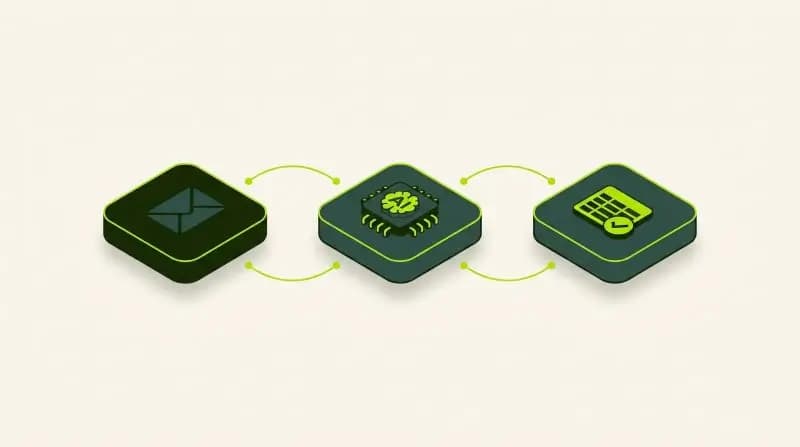
Learn to build AI workflows that handle your busywork — live sessions, real projects, zero code.
See the courseBeginner-friendly