.jpg&w=1080&q=75)

The Invisible Interface: When Voice UI Meets Multi-Agent Orchestration

Look at your phone. Look at the grid of app icons. Look at your desktop with its overlapping browser tabs. We have spent the last thirty years interacting with computers by clicking buttons on 2D glass rectangles.
But as the capabilities of LLMs and speech models reach human parity, we are rapidly transitioning toward a radical new paradigm: the Invisible Interface. When real-time Voice UI meets multi-agent backend orchestration, the screen itself becomes optional.
Moving Past Alexa and Siri
We have had Voice UI for years. But early assistants were just voice-activated search engines. You asked for the weather, and a robotic voice read a script. They were frustrating, linear, and utterly incapable of executing multi-step tasks.
Modern Voice UI AI agents are different. Thanks to breakthroughs in ultra-low latency models (like GPT-4o and advanced Claude integrations) and hyper-realistic TTS (like ElevenLabs), a voice agent can hold a fluid, interruptible, highly nuanced conversation.
But the real magic happens when that voice is connected to a Brain.
Voice Orchestration via n8n
Imagine driving to work and saying out loud: Pull up my sales figures for Q3, identify my lowest-performing client, and draft a personalized outreach email to them offering a 10% discount to re-engage.
In the post-screen computing era, this isnt science fiction; it is basic n8n orchestration.
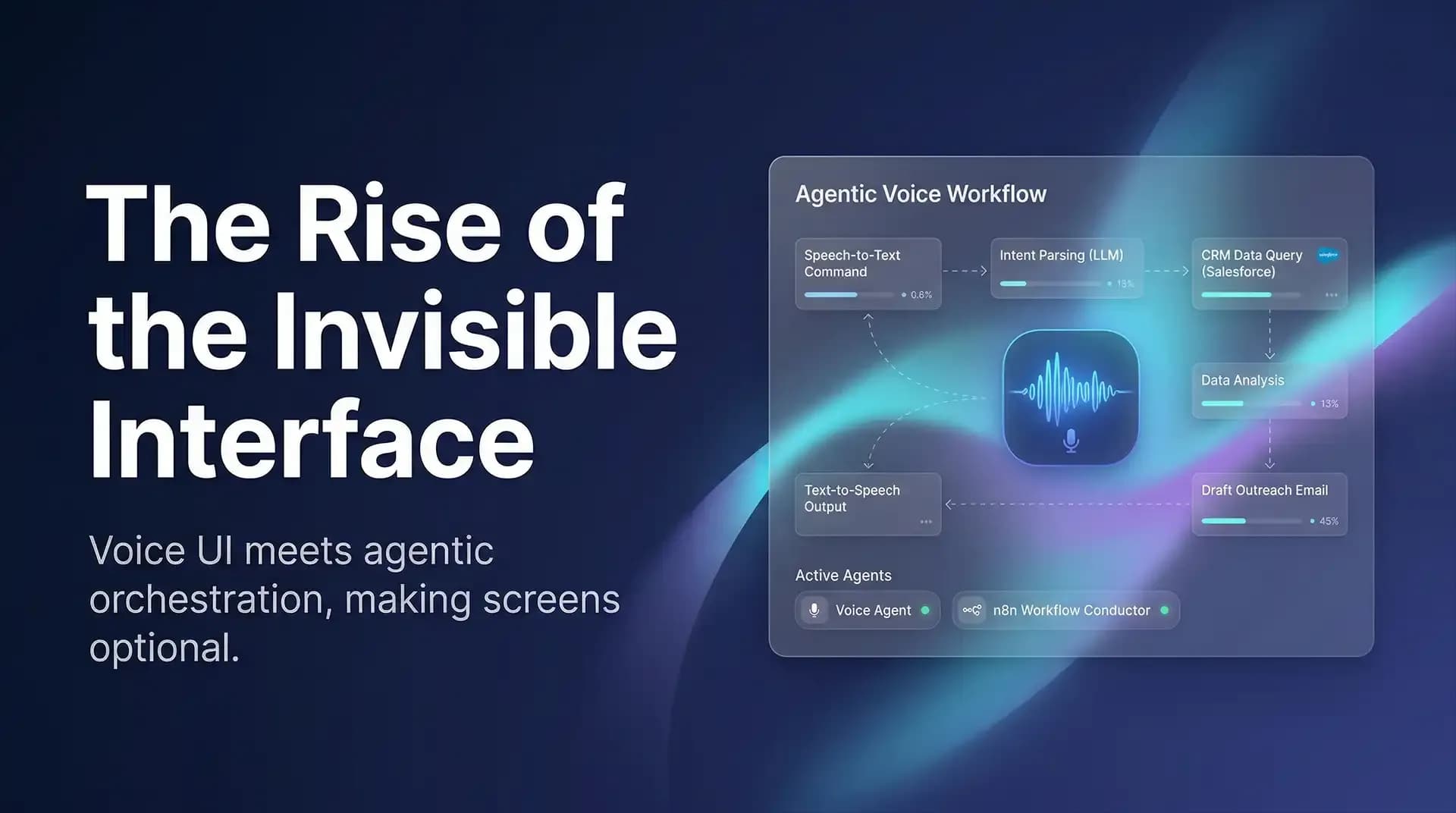
The invisible interface AI workflow looks like this:
- Speech-to-Text:The audio command is transcribed perfectly.
- Intent Parsing:An LLM understands a multi-step request.
- Agent Action (n8n):The system triggers APIs to query your CRM (Salesforce), run the data analysis, and draft the email in your outbox.
- Text-to-Speech:The agent reads the draft back to you via your cars bluetooth and asks, Shall I send it?
You conducted a complex business operation without looking at a single pixel.
The Conductor Needs No Buttons
The true friction in computing is the interface. Keyboards and mice are translation devices for human intent. Voice UI combined with Agentic AI removes the translation layer. You simply speak your intent, and the autonomous agents figure out the how.
Your role shifts entirely from Operator to Conductor.
Conclusion: Prepare for Screenless Workflows
The builders of 2026 are not designing glossy web apps; they are designing robust, invisible data pipelines.
If you want to understand how to build the backend workflows that will power the voice-first revolution,enroll in the Zero to AI 90-Day Reskilling Workshopand master the future of orchestration.
Learn to build AI workflows that handle your busywork — live sessions, real projects, zero code.
See the courseBeginner-friendly