.jpg&w=1080&q=75)
Why You Keep Failing at Learning AI (And How to Finally Make It Stick)

Why You Keep Failing at Learning AI (And How to Finally Make It Stick)
Here is an uncomfortable number: over 70% of people who start an AI learning journey quit before they ever build anything useful.
That is not a talent problem. That is not an intelligence problem. It is a method problem — and the good news is, methods can be fixed.
If you have started a course, watched a few hours of YouTube, told yourself "I'll get back to it this weekend," and then never did — this article is written for you. We are going to break down exactly why your AI learning keeps falling apart, and then give you the concrete fixes to finally learn AI effectively and make it stick for good.
The #1 Reason AI Learning Fails: Tutorial Hell
You know the loop. You watch a tutorial. It makes sense. You feel good. You watch another one. It also makes sense. You feel great. Then someone asks you to do something on your own and your mind goes completely blank.
Welcome to tutorial hell.
Tutorial hell is when you spend all your time consuming content about AI without ever producing anything with it. The videos feel productive. The courses feel like progress. But passive consumption does not build real skill — it builds the illusion of skill.
Educational psychology has confirmed this for decades: active learning produces dramatically better outcomes than passive learning. Watching someone else solve a problem is almost nothing like solving it yourself. Your brain needs friction, struggle, and iteration to actually wire a new skill into memory.
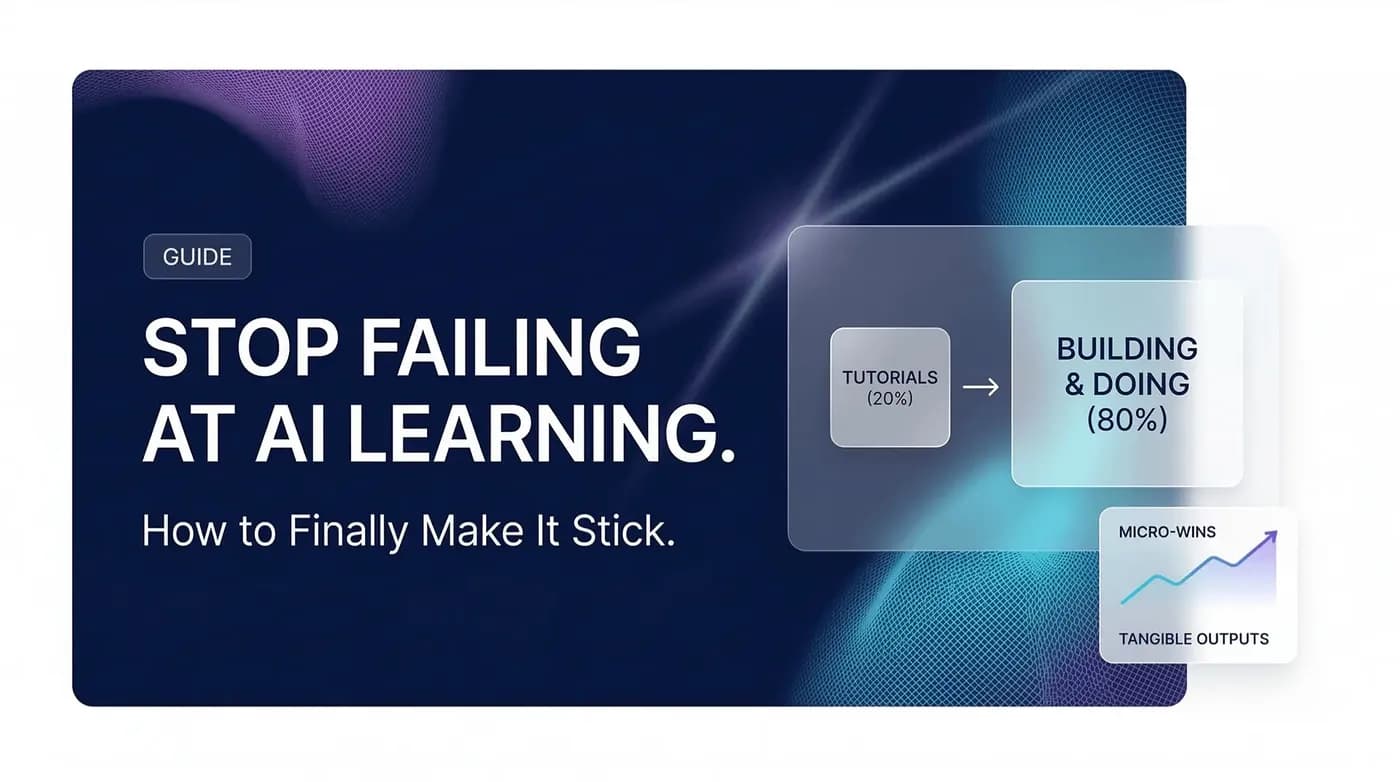
The fix: Adopt the 80/20 rule for AI learning. Spend 20% of your time on tutorials and reading, and 80% of your time building. Even small projects — summarizing your meeting notes with ChatGPT, automating a repetitive spreadsheet task, writing your first prompt chain — count. Start doing before you feel "ready," because that feeling never arrives on its own.
Mistake #2: Starting Too Big (And Crashing Too Hard)
"I'm going to learn machine learning, deep learning, neural networks, NLP, and get a job as an AI engineer in six months."
Ambitious. Admirable. Also a near-guaranteed path to burnout.
When beginners set impossible-sized goals, the first hard week feels like failure. The first confusing concept feels like a wall. And the first time life gets busy, the whole thing gets dropped.
This is called the scope trap, and it kills more AI learning journeys than any technical difficulty ever could.
The moment you decided to "learn AI" as a single goal, you lost. AI is not one thing — it is a vast continent of disciplines. You cannot conquer a continent. You can explore a specific city.
The fix: Pick one tiny, specific, useful thing to learn. Not "machine learning" — but "how to write better prompts for my marketing work." Not "AI engineering" — but "how to use Claude to summarize long PDFs faster." One skill. One tool. One application. Get a win there first. Then expand.
"When motivation tanks, shrink the goal: code for 10 minutes, not 10 hours. Celebrate micro-wins — your first working model deserves recognition."
— DataCamp's 2026 AI Learning Guide
Mistake #3: Chasing the Latest Thing Instead of Building Foundations
The AI space moves fast. Extremely fast. A new model drops, a new tool launches, a new technique trends — and if you are a learner, your social media feed is screaming at you to drop everything and pay attention.
This is the shiny object trap for AI learners: perpetually starting over, always chasing what is new, and never going deep enough on anything to actually develop competence.
Here is the truth nobody in the hype machine wants to tell you: the core concepts behind AI have not changed much in years. Large language models, prompting principles, understanding AI limitations, applying AI to workflows — these fundamentals are durable. The specific tools change. The underlying logic does not.
The fix: Deliberately ignore new tools for your first 60 days of focused AI learning. Pick one LLM (ChatGPT or Claude are great starting points), one use case relevant to your actual work, and go deep. Once you understand why a tool works, learning new tools later takes days, not months. Foundation first. Novelty second.
Mistake #4: Learning Alone in Silence
Most people try to learn AI the way they study for an exam: read, watch, take notes, repeat. Solo. In silence. Without feedback.
This works fine for memorizing facts. It works terribly for developing a practical skill.
Learning AI effectively requires you to get things wrong in front of people — or at least in contexts where you get real feedback. That means sharing your prompts and asking "how could this be better?" That means joining communities where people are building things. That means having someone challenge your assumptions.
Beginners often hesitate to ask questions out of fear of looking inexperienced. That fear is expensive. It slows your learning by months.
The fix: Join an AI learning community. Reddit's r/learnmachinelearning and r/AIToolsTech are active. LinkedIn is full of practitioners sharing real workflows. Platforms like Zero To AI are built specifically to help beginners navigate AI without judgment. Visibility accelerates learning. Ask the "dumb" question. It is almost never actually dumb.
Mistake #5: Skipping the "Why" and Going Straight to the "How"
Most AI tutorials rush you straight into the mechanics. Type this command. Run this code. See the output. Next lesson.
But if you do not understand why something works — why a certain type of prompt gets better results, why a model hallucinates in certain contexts, why one tool fits your use case better than another — you cannot adapt when things go wrong. And in AI, things go wrong constantly.
Understanding the underlying logic is what separates people who can use AI flexibly from people who can only follow scripts.
The fix: Before you start any tutorial, spend 15 minutes asking: "What problem does this actually solve? How does it approach that problem?" After you finish, spend 10 minutes asking: "Why did that work? What would happen if I changed one variable?" This habit alone will accelerate your retention dramatically.
Mistake #6: Measuring Progress by Hours Spent, Not Outcomes Built
"I spent 12 hours on AI this week." Okay — but can you do anything new with AI this week that you could not do last week?
Time spent is a terrible proxy for learning progress. You can log 12 hours in tutorial hell and emerge with zero new capability. You can spend 90 focused minutes building a real tool and emerge with a skill you will keep for years.
This is one of the most common traps in self-directed learning. Effort feels like progress. Busyness feels like growth. But unless your learning produces a tangible output — something you made, something you automated, a problem you solved — the hours do not stack.
The fix: Track outputs, not hours. At the end of every week, ask: "What can I now do with AI that I could not do before?" Keep a simple log. Even one new capability per week compounds massively over a year.
The Framework That Actually Makes AI Learning Stick
Here is what effective AI learning looks like when you put all the fixes together:
Phase 1: Get a Quick Win (Week 1-2)
Pick one real problem in your life or work that AI could help with right now. Spend your first two weeks entirely focused on solving that one problem using one tool. No branching out. Just solve the problem.
Phase 2: Go Slightly Deeper (Week 3-6)
Now that you have one working example, ask: "What adjacent skill would make this even better?" Maybe it's better prompting. Maybe it's connecting two tools. Expand from your working foundation — do not start over.
Phase 3: Build Something Shareable (Week 7-10)
Create something small that you could show another person. A prompt template. A simple automation. A short explainer about what you learned. Teaching is the highest form of learning, and making things shareable forces you to truly understand what you have built.
Phase 4: Repeat and Specialize
You now have a system. Find the next problem. Go through the cycle again. Each loop builds on the last. Within three to four months, you have a real, functional AI skill set — not just a collection of half-finished courses.
The Mindset Shift That Changes Everything
The hardest part of learning AI effectively is not technical. It is psychological.
It is learning to be comfortable being bad at something publicly. It is learning to stay the course when the hype machine says you are behind. It is learning to measure yourself against your past self, not against the LinkedIn posts of people who have been at this for five years.
AI is not going anywhere. The learners who win are not the ones who started first — they are the ones who built the most consistent practice. Ten minutes a day beats ten hours once a month every single time.
You have not failed at learning AI. You have just been using the wrong method. Now you have a better one.
Frequently Asked Questions
How long does it actually take to learn AI effectively?
With focused, project-based practice, most people develop genuinely useful AI skills within 4-8 weeks. "Learning AI" comprehensively is a career-long journey, but being productive with AI tools can happen in under a month.
Do I need to know coding to learn AI?
Not to use AI effectively. Tools like ChatGPT, Claude, Gemini, and no-code platforms like Zapier AI and Make allow you to build powerful AI workflows with zero code. Coding helps if you want to build AI systems, but it is not a prerequisite for leveraging AI in your work.
What is the best first step to learn AI?
Start with one real problem and one tool. Do not start with a course — start with a task. Use ChatGPT or Claude to solve something you actually need solved today. The learning will follow from genuine use.
Why do I keep forgetting what I learn in AI courses?
Because passive watching does not create durable memories. The brain consolidates knowledge through retrieval and application — doing something with what you learned. Start building projects immediately, even tiny ones.
Is it too late to start learning AI?
No. The tools in 2026 are more accessible than they have ever been. Non-coders have more leverage than ever before. The best time to start was a year ago. The second-best time is today.
Start Learning AI the Right Way
Stop restarting. Stop watching from the sidelines. Stop waiting until you know enough to feel confident — that day does not come from watching more videos.
Zero To AI is built for exactly this: helping real people with real goals learn AI in ways that actually stick. Whether you are starting from zero or trying to finally break out of the tutorial loop, you will find structured, judgment-free guidance that meets you where you are.
Visit zerotoai.in to find your path and start building — not just watching.
The next version of your career is one real project away. Let's build it.
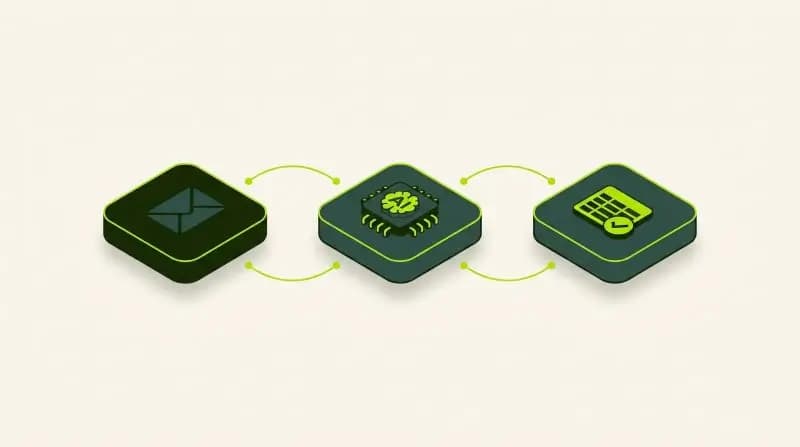
Learn to build AI workflows that handle your busywork — live sessions, real projects, zero code.
See the courseBeginner-friendly